Barcelona clicks into place fast from a bus. This hop-on hop-off tour is a comfortable way to see Gaudí’s Sagrada Família and other top sights across the city without planning every turn.
I especially like the freedom: you hop off, wander, then jump back on when you’re ready. I also like that the buses run frequently with clear stop names and a headset audio guide in 16 languages. One consideration: the last bus is at 7pm, so you need a return plan if you stay out late or get stuck walking uphill.
In This Review
- Key Things That Make This Hop-On Hop-Off Tour Work
- The Real Value: Orientation Plus Flexible Sightseeing
- Tickets, Route Timing, and How Not to Get Burned by the 7pm Finish
- What You Get Onboard: Headsets, Wi‑Fi, Maps, and Real-World Comfort
- Red Line: Gaudí, Montjuïc, and the Port to the Beaches
- Blue Line: Modernisme, Tibidabo Area, and Camp Nou
- How I’d Build Your Day: First-Day Strategy and Photo Timing
- Stops That Need Extra Thought: Walking Distances, Signposting, and Where to Stay Put
- Price and Value: Why $39 Can Be a Bargain or a Miss
- Who This Tour Suits Best (And Who Should Skip It)
- Should You Book This Hop-On Hop-Off Bus Tour?
- FAQ
- How long is the bus tour circuit?
- What ticket options are available?
- What time do the buses start and end?
- How often do buses run?
- Is the audio guide included, and in how many languages?
- Is Wi‑Fi included on the buses?
- Are attraction tickets included?
- Are pets allowed on the bus?
- Are smoking or vaping allowed?
Key Things That Make This Hop-On Hop-Off Tour Work

- Two route choices help you cover both the center and the outer sights without crisscrossing
- Open-top double-decker views make it easier to spot landmarks fast, even when you just want photos
- 38 stops gives you real flexibility, not just a quick pass-by of the big names
- Audio guide in 16 languages keeps you from wandering without context
- Frequent departures reduce the wait time between stops, especially for popular areas
- Sagrada Família and La Rambla access means you can mix major monuments with nightlife energy
The Real Value: Orientation Plus Flexible Sightseeing

Barcelona is a city you can feel in layers. You’ve got the tidy geometry of Eixample, the storybook lanes of the Gothic Quarter area, and then the big architecture moments that make you look up and keep looking. This bus tour helps you stitch those layers together quickly, because you’re not committing to one long walking route.
I like that it’s not just sitting and watching from a seat. With hop-on hop-off, you can treat the bus like your moving baseline, then pick the exact stops that match your mood. If you want photos and context, you can do that. If you want a longer break to eat, shop, or stroll, you can do that too.
Price-wise, the tour is positioned as a one-ticket way to handle a lot of geography. At $39 per person, it’s not the cheapest way to get around, but it can be good value if you’re trying to cover multiple neighborhoods in limited time. You’re basically buying transportation plus commentary plus stop-by-stop access to major sights.
Tickets, Route Timing, and How Not to Get Burned by the 7pm Finish
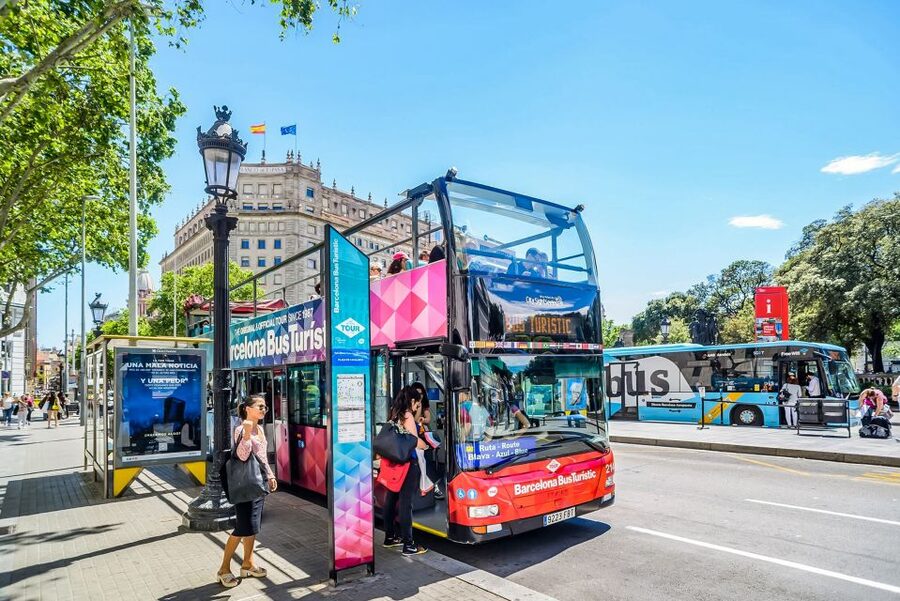
You’re choosing between a 24-hour or 48-hour ticket. The tour itself is listed as 120 minutes, which is a useful idea for how long one full circuit takes, but your real experience is longer because you’ll hop off and stay longer at stops.
The operational rhythm matters:
- First bus departs at 9am
- Last bus departs at 7pm from Stop 1
- Buses run about every 20 minutes
- In high season, the service is noted as more frequent, with exclusive buses running every 5 minutes
Here’s the practical part: plan your last big hop-off with daylight and your energy in mind. One review noted that the buses stop at 7pm no matter where you are, and you may need a taxi back. So if you’re eyeing a late stop like the Sagrada Família area or a beach-side stretch, don’t assume you’ll be able to ride the final bus no matter what.
Also note two simple rules:
- A 48-hour ticket must be used on consecutive days
- Your ticket is valid for 1 to 2 days, based on what you choose
What You Get Onboard: Headsets, Wi‑Fi, Maps, and Real-World Comfort

This tour includes an audio guide in 16 languages, with headphones provided onsite. Free Wi‑Fi is included too. In real life, Wi‑Fi performance can vary, and one review mentioned it wasn’t working on every bus, but the audio is the main help you’re relying on.
The buses are open-top double-deckers, so you’ll get sky views for pictures. In cooler months, the top deck can feel chilly, and in hot months you might find it warm on exposed upper levels. One review mentioned the need for better air conditioning, so if summer heat is intense for you, aim to balance top-deck time with breaks in the shade or lower deck.
Weather-wise, there’s a smart touch: one review said that when rain starts, the roof can close automatically to keep passengers dry. That’s the kind of detail that keeps a “quick orientation ride” from becoming a soggy mess.
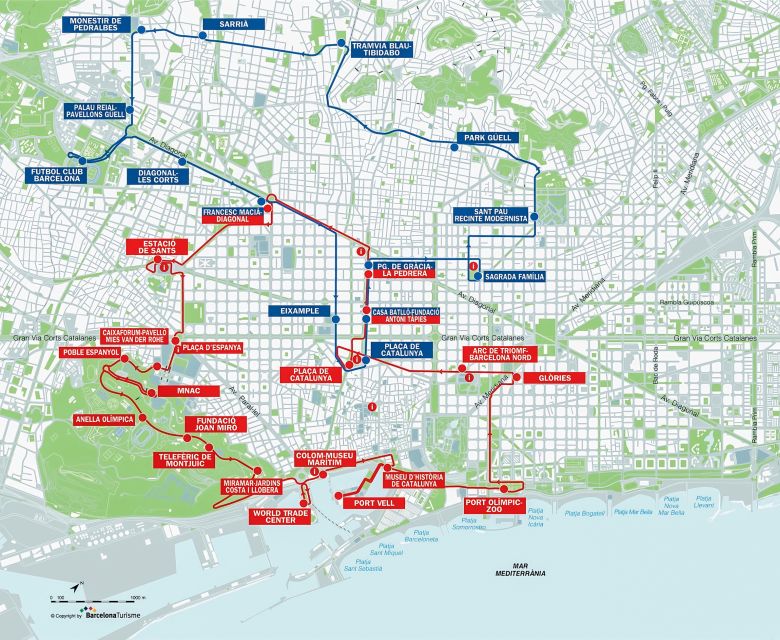
Red Line: Gaudí, Montjuïc, and the Port to the Beaches
The Red Line is your best match if you want a sweeping route that ties together Gaudí landmarks, Montjuïc-side viewpoints, and then stretches toward the waterfront and beaches. It’s also the line that naturally feeds into the kind of city day where you hop off for an hour, then hop back on to move to the next neighborhood.
Here’s what each Red Line stop is good for, plus a heads-up where you might lose time:
- Plaça de Catalunya – The central starting hub for orientation and easy transfers.
- Casa Batlló / Fundació Antoni Tàpies – Gaudí exterior views plus an arts stop area.
- Eixample – A quick feel for the grid layout and the broader city structure.
- Estacio de Sants – Handy rail access zone if your plans include trains.
- Plaça d’Espanya – A gateway zone toward Montjuïc and major transit lines.
- CaixaForum – A modern landmark building you can use as a visual anchor.
- Poble Espanyol – A themed Spanish village area where you can wander.
- Museu Nacional d’Art de Catalunya (MNAC) – Big museum presence with impressive views from the hill area.
- Anella Olímpica – Olympic-era grounds and wide-open spaces for photos.
- Fundació Joan Miró – Modern art nearby if you want a culture break.
- Telefèric de Montjuïc – A clue that you’re close to cable-car territory and viewpoints.
- Miramar – Jardins Costa i Llobera – Lookouts that make the Montjuïc effort feel worth it.
- World Trade Center – Transition from classic sights toward waterfront energy.
- Colom – La Rambla – Your route toward La Rambla’s classic strolling and bar scene.
- Museu d’Història de Catalunya – A history-focused stop that adds context to what you’re seeing.
- Port Olímpic – Marina atmosphere and flat walking for when you don’t want steep climbs.
- Platja del Bogatell – Beach time without going far out of the city.
- Platja Nova Mar Bella – Another beach option for a different coastline vibe.
- Forum – A modern urban zone that contrasts with Barcelona’s older core.
- Parc Diagonal Mar – A green break along the coast-side corridor.
- Poblenou – A neighborhood that feels more local and less postcard-only.
- Torre Glòries – A skyline landmark when you want modern Barcelona in the frame.
- Sagrada Família – The big icon stop, and it’s a strong photo location.
- Arc de Triomf – A triumph-arch landmark that fits well into a walking plan.
Two practical notes for the Red Line:
- If you want Sagrada Família photos, the stop is a good starting point, and one review specifically called out great photo angles from the area behind the basilica.
- Some stops are best for short visits or photo pauses. If you want a long sit-down break, pick stops that are flatter, like Port Olímpic or the beach-side zones.
Blue Line: Modernisme, Tibidabo Area, and Camp Nou
The Blue Line feels like the route for architecture and upper-neighborhood scenes. It’s also the one that pays attention to big “Barcelona identity” stops like Park Güell and the Modernisme sites. If you’re planning only one full day, a smart strategy is to use the Blue Line early for top sights that otherwise require more figuring out.
Stop-by-stop, here’s what the Blue Line covers:
- Plaça de Catalunya – Same central hub, for orientation and easy first-day routing.
- Casa Batlló / Fundació Antoni Tàpies – Again, Gaudí plus an art-focused pairing depending on your interests.
- Passeig de Gràcia – La Pedrera – Another famous Gaudí façade area for iconic exterior views.
- Sant Pau Recinte Modernista – A standout Modernisme complex, ideal if you like architectural details.
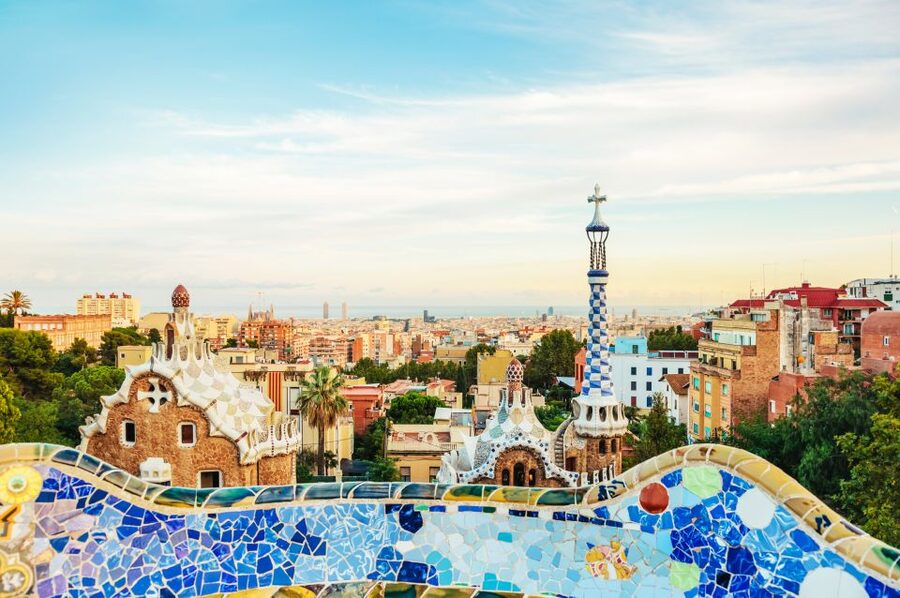
- Park Güell – Gaudí’s park area and one of Barcelona’s most photographed landscapes.
- Tramvia Blau – Tibidabo – A Tibidabo-side access zone with a different, elevated feel.
- Sarrià – A residential neighborhood stop if you want a calmer slice of the city.
- Monestir de Pedralbes – A monastery stop that reads as peaceful and historic from the outside.
- Palau Reial – Pavellons Güell – Gaudí pavilions area that connects palace imagery with Modernisme style.
- Futbol Club Barcelona – The Camp Nou area stop for football fans and match-day planning.
- Diagonal – Les Corts – A major artery for moving through town with minimal hassle.
- Francesc Macià – Diagonal – Another Diagonal corridor point for city navigation.
- Eixample – A second pass through the city’s grid neighborhoods.
- Sant Antoni – A neighborhood finish that can set you up for evening strolling.
Here’s the drawback to plan around: Park Güell. One review said the bus dropped them off at a distance from the park gate, resulting in a long, steep uphill walk that not everyone could manage. So if steep walking is a problem for you, treat Park Güell as a planned outing. Also check how you’re getting from the stop to the entrance before you hop off.
On the plus side, the Blue Line includes the kind of stops that help you connect architectural dots. You’re less likely to see just one monument and miss the bigger story of the city’s styles.
How I’d Build Your Day: First-Day Strategy and Photo Timing
If you’re wondering what order makes sense, I’d use a simple logic: start where you need orientation, then build around what you loved. Many people find it works best to do the Blue Line first in the morning and then the Red Line later, but you should feel free to swap based on where your hotel sits and what you want most.
Here’s a practical model you can copy:
- Morning: Pick the route with the big “must-see” architecture and Modernisme stops.
- Midday: Hop off at a museum area or a walkable neighborhood zone, then come back to the bus before you get tired.
- Afternoon: Use the second route to connect waterfront, beach, and the iconic Sagrada Família area.
- Evening: If you want La Rambla energy, plan it for the Red Line side and aim to be back on the bus earlier than you think.
Photo reality check: the bus moves, the top deck can vibrate a little at city speed, and stops don’t last forever. One review mentioned difficulty taking photos at certain points and that the schedule keeps the timing tight. So if you care most about a single façade shot, don’t rely on a quick glance. Plan a hop-off there, walk a few minutes if needed, then take your time.
Also, if you love sitting upstairs, remember you may have to be quick to get to the top deck during stops. One review said the driver sometimes didn’t allow enough time for people to move upstairs, so be prepared to choose your deck position early.
Stops That Need Extra Thought: Walking Distances, Signposting, and Where to Stay Put
This is a hop-on hop-off bus, so the “work” is mostly on your side. Your best move is to treat each stop as a starting point, not a guaranteed front-door drop-off to every attraction.
A few patterns to know:
- Some attractions are uphill. Park Güell is the big example from the information you have here.
- Some areas are good for photos but not for long stays. Beach zones and broad waterfront stops can be great, but you’ll want to manage sun and walking.
- Signposting can be hit or miss. One review complained that some places weren’t well signposted when getting off, and another noted trouble finding a stop around the Sagrada Família area.
My advice: before you hop off, glance at the map you get with the tour and circle what you’re doing next. Then keep your return plan simple: when you finish, go back toward the stop area instead of trying to wander back by memory.
Price and Value: Why $39 Can Be a Bargain or a Miss
At $39 per person for the bus tour, the value depends on how many places you want to cover. If you only plan to see one or two sights and you’re staying within walking distance of them, it may feel overpriced. But if you’re trying to cover a lot of Barcelona in a short window, it can feel like a bargain because you’re combining transport, audio guidance, and stop access.
It can be especially good value if:
- You want both center sights and outer neighborhoods
- You dislike transit transfers and prefer one ticket to move you
- Your trip is tight and you want to reduce decision stress
One caution is that the price can also feel like a stretch if you’re going to spend most of the time in just one or two areas. This tour shines when you actually use the hop-on freedom.
Also, consider the 48-hour option if you have time. One review said it was worth planning stops out and using the bus as more than a quick sightseeing loop. A second day lets you slow down and avoid rushing from one icon to the next.
Who This Tour Suits Best (And Who Should Skip It)
This tour fits you if you want:
- A low-stress way to see multiple neighborhoods
- A guided narrative via headset audio
- A flexible itinerary that doesn’t collapse if your energy changes
It’s also a nice match for families who want fewer long walking stretches, especially if you’re dealing with kids or teenagers who tire out quickly.
You might want to think twice if:
- You hate stairs and steep walking (Park Güell is the clearest example)
- You want a tightly scheduled, door-to-door guided experience
- You’re planning to stay out past the 7pm service window without backup transportation
Should You Book This Hop-On Hop-Off Bus Tour?
I’d book it if you want a smart first pass through Barcelona’s big areas, especially with Sagrada Família, Gaudí architecture, and the mix of city and seaside neighborhoods. The frequency and the audio guide do real work for you, and the stop network makes it easy to shape a day that doesn’t require constant map-checking.
If steep walking can be an issue, I’d still book it but plan carefully around Park Güell and be ready to use taxis or other routes if you don’t want uphill stress. And if you’re the type who tends to linger at dinner or nightlife, set your “final hop-off” earlier than you think, because the 7pm end time can catch you by surprise.
If your goal is maximum sights with minimum logistics, this is one of the most practical ways to make that happen in Barcelona.
FAQ
How long is the bus tour circuit?
The tour duration is listed as 120 minutes.
What ticket options are available?
You can choose a 24-hour or 48-hour hop-on hop-off bus ticket.
What time do the buses start and end?
The first bus departs from Stop 1 at 9am, and the last bus departs from Stop 1 at 7pm.
How often do buses run?
Buses run every 20 minutes. The service is also noted as running every 5 minutes in high season.
Is the audio guide included, and in how many languages?
Yes. The audio guide is included with headphones and covers 16 languages.
Is Wi‑Fi included on the buses?
Yes, free Wi‑Fi is included.
Are attraction tickets included?
No. Attraction tickets are not included in the tour price.
Are pets allowed on the bus?
No, pets are not allowed.
Are smoking or vaping allowed?
No, smoking is not allowed.