Budapest is best when you can move fast. This hop-on hop-off bus lets you pace your day, then you add a guided walk to fill in the streets the bus can’t reach. You’re looking at big-ticket sights like St Stephen’s Basilica, the Parliament area, and the Jewish Quarter without cramming your schedule.
What I like most is the freedom: you can ride once to get your bearings, then hop off where you actually want time. I also really value the practical extras built into the ticket, including an English walking tour and an audio guide in 15 languages.
One thing to keep in mind: the bus loop is only one route, so if you get off in the wrong order, you can waste time waiting for the next pass. In busy stretches, you’ll also want to plan around traffic and crowded stops.
In This Review
- Key things to know before you board
- Why Budapest’s hop-on hop-off bus beats a rigid day plan
- Price and value: what $41 really buys you
- Pass strategy: how to use 24, 48, or 72 hours without wasting time
- The Red Line route: 20 stops that connect Pest and Buda
- Stop-by-stop highlights (and what to watch for)
- The 11am walking tour: Parliament, Shoes on the Danube, and Váci Street
- Audio guide in 15 languages: what you actually get on the bus
- Extras and discounts: the river cruise situation you should check
- Practical tips to make the bus smoother (especially in busy seasons)
- Is this tour worth booking? My decision rule
- FAQ
- What time does the Red Line start and end from Stop 1?
- How often do the buses run?
- How long is a full Red Line circuit?
- Where does the walking tour meet, and what time does it start?
- Is the walking tour narrated, and what language is it in?
- What languages are available for the audio guide on the bus?
- Does the ticket include the Danube boat tour?
- Is this hop-on hop-off bus wheelchair accessible?
Key things to know before you board

- 24, 48, or 72 hours makes the bus more useful than a one-and-done sightseeing loop
- Red Line runs 9am to 5pm from Stop 1, with buses every 10–20 minutes
- Walking tour at 11am (English only) covers Parliament, Shoes on the Danube Bank, Váci Street, and Danube Promenade
- 20 stops connect major landmarks across both Pest and Buda
- Audio guide in 15 languages helps you understand what you’re actually seeing from the top deck
- Discount booklet + river cruise option can add value if you time it right
Why Budapest’s hop-on hop-off bus beats a rigid day plan
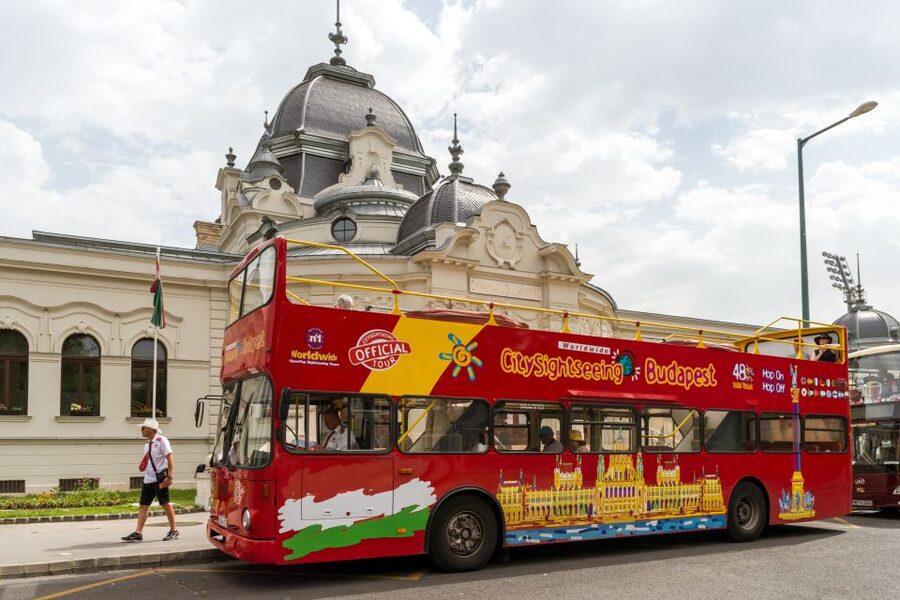
Budapest has two personalities. Pest is flatter and city-slick. Buda climbs and rewards effort. This bus is a smart way to handle both without turning your vacation into an endurance test.
I like that it’s built for flexibility. You can do a full loop first—find the landmarks, check what’s worth a long stop, then come back for museums, viewpoints, or just another photo angle. The route also hits practical “navigation anchors” like the Keleti area and the Parliament end of town, so you’re not stuck riding in circles with nowhere useful to go.
The other reason it works is the pairing with a guided walking tour. The bus can’t get you into every historic pocket. The walk fills those gaps with a timed, structured route you can’t easily recreate on the fly.
Price and value: what $41 really buys you
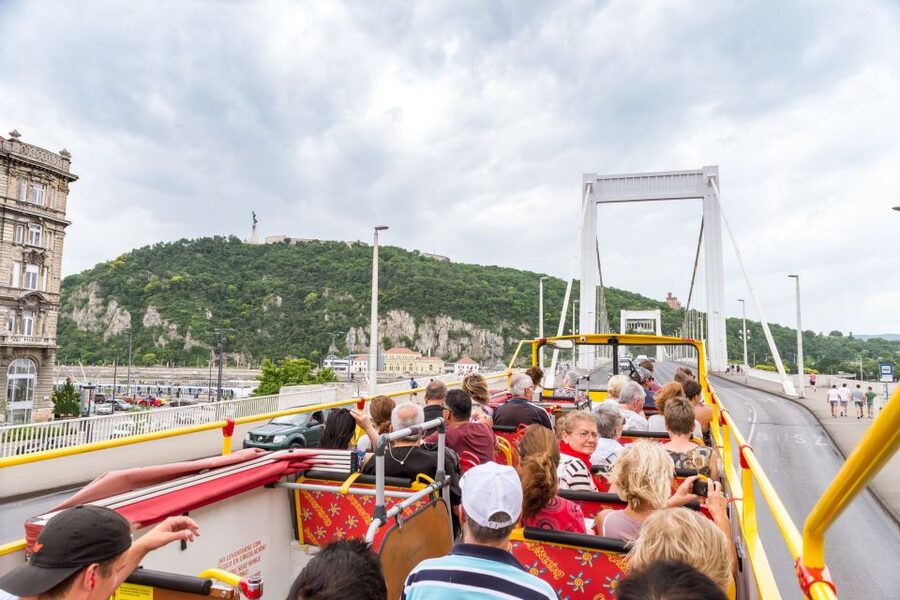
At about $41 per person, the value comes from stacking benefits, not from any single “wow” moment. Your ticket includes:
- A 24, 48, or 72-hour hop-on hop-off bus pass
- A guided walking tour (1 hour, English only) in the areas the bus cannot cover
- An audio guide available in 15 languages
- Access to stops near major sights, plus a discount booklet
If you’re the type who likes to wander, this pricing makes sense because the pass becomes transportation as much as sightseeing. You can use the bus like a moving base—hop off, explore, and hop back on when your legs start issuing complaints.
If you only want a quick overview, a 24-hour pass can be enough. But if you want to visit multiple sites on different parts of the city—especially Buda—the 48 or 72-hour options tend to pay off faster.
Pass strategy: how to use 24, 48, or 72 hours without wasting time

The Red Line runs 90 minutes per full circuit, and buses run every 10–20 minutes. That schedule is ideal for a simple plan:
- Day 1: Ride the whole loop. Hop off only briefly for a photo or quick look, then get back on.
- Day 2 (or Day 3): Do slower visits where the bus drops you closest.
- Keep the timing in mind: the first departure from Stop 1 is 9am and the last departure is 5pm.
Also, your “clock time” matters. People find the pass easiest when they start midday one day and use it across multiple days. The key is not to treat it as a strict calendar day—use it as an hours-based window.
The Red Line route: 20 stops that connect Pest and Buda
The route is a loop with 20 stops. You’ll see the major sights in stages, and each cluster helps you decide where to spend time.
Stop-by-stop highlights (and what to watch for)
Stop 1: St Stephen’s Basilica
This is the classic starting point and a great way to begin with a “wow” facade. If you’re doing the walking tour, you’ll also see this area from both bus and foot perspectives.
Stop 2: Chain Bridge (Pest)
This is the big crossing view. From here, you can understand why Budapest looks the way it does—two hills, a river in between, and landmarks marching along the banks.
Stop 3: Jozsef Attila Street
A transition stop that helps you break up the ride as you move east-west across Pest.
Stop 4: Dohany Street Synagogue
This is one of the top reasons to take the bus. You’ll be dropped close to the Jewish Synagogue area and the broader Dohány Street sights.
Stop 5: Astoria (temporarily closed)
You may see this listed, but if it’s closed during your visit, plan to get off at nearby functional stops instead.
Stop 6: Andrassy Avenue
This is where the city’s grand boulevard feeling kicks in. Great for street-level architecture shots while still staying on a guided bus loop.
Stop 7: Hungarian State Opera House
A landmark exterior stop. Even if you don’t go inside, the building is worth a look.
Stop 8: Liszt Ferenc Square
A useful refuel spot for walking breaks between major sights.
Stop 9: Heroes’ Square
This is a “you came to Budapest” moment. Expect strong viewpoints and lots of space to take in the monument shapes.
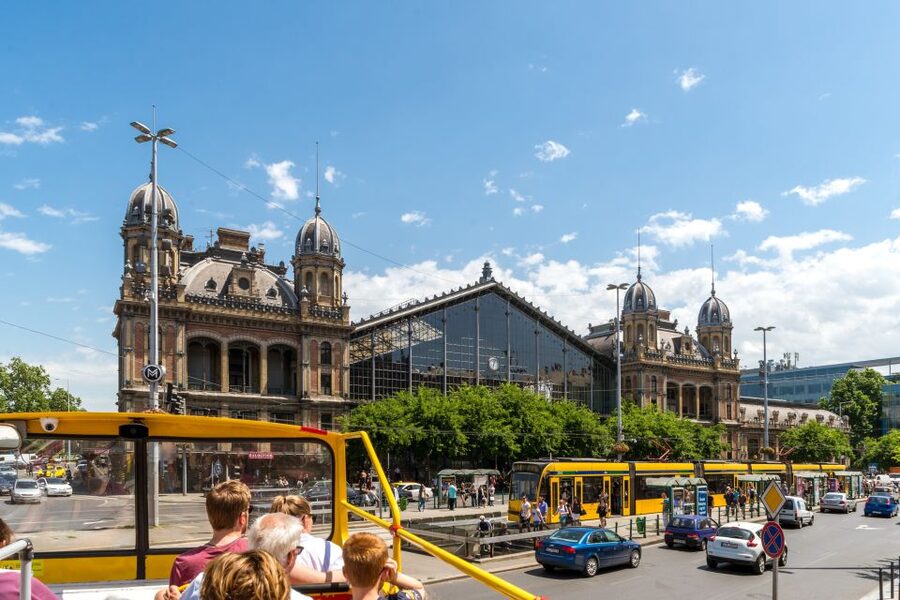
Stop 10: Keleti Railway Station
This stop can be practical more than pretty. It’s useful if your lodging is in that general area, but it’s not the main postcard attraction.
Stop 11: New York Palace
Another architecture-focused stop. If you like ornate buildings and old-school grandeur, this one’s a win.
Stop 12: Astoria (temporarily closed)
If Stop 5 is closed, plan for similar frustration here. Use the loop as a navigation tool, not a guarantee.
Stop 13: Parisi Passage Cafe
A pleasant stop for a coffee break vibe and a little “wandering energy” if you’ve already had your fill of museums.
Stop 14: Gellert Square
This brings you toward the Buda side’s viewpoint territory. It’s a good place to time your hop-off if you want river-and-hills views.
Stop 15: Castle Garden
If you want the Buda Castle area, this is the start of that climb-and-stroll zone.
Stop 16: Funicular
This stop is handy for understanding how people get between levels. It’s also a useful point if you plan to connect onward.
Stop 17: Batthyany Square
A key crossing point into a more residential or riverside-feeling stretch of Buda.
Stop 18: Margaret Bridge (Buda)
This stop is for river views and the feeling that Budapest is designed for scenic walking, not just point-to-point sightseeing.
Stop 19: WestEnd Shopping Centre
Not a classic sightseeing headline, but it’s useful if you need food, restrooms, or a shopping stop without planning ahead.
Stop 20: Parliament
This is the final “big one.” If you’re into architecture, it’s a logical stop to linger—especially if you’ve also done the walking tour route that connects to the Parliament area.
The 11am walking tour: Parliament, Shoes on the Danube, and Váci Street
The walking tour starts daily at 11am from Szent Istvan ter 1, 1051, Hungary. It lasts about 1 hour and focuses on areas the bus can’t cover well.
What it covers is exactly where your eyes want help:
- St Stephen Basilica
- Parliament area
- Shoes on the Danube Bank
- Váci Fashion Street
- Danube Promenade
It’s narrated in English only. I like this format because it’s short enough to fit into a busy day, but long enough that you get real wayfinding and context. In a few past experiences I’ve read, guides like Claudia, Joan, Rebecca, and Souvar were singled out for energy and humor—so if you get one of those personalities, the tour tends to feel like a conversation, not a lecture.
Practical tip: arrive early enough to confirm you’re at the correct meeting point. Some people found the start easy to miss when instructions weren’t crystal clear, and you don’t want to lose your 11am window.
Audio guide in 15 languages: what you actually get on the bus
The audio guide is one of the smartest features here. It’s included and available in Spanish, Turkish, Chinese, English, Finnish, French, German, Greek, Hebrew, Hungarian, Italian, Japanese, Arabic, Polish, Portuguese, Russian.
You’ll get commentary as you ride, so you’re not staring at buildings and guessing what you’re seeing. That matters in Budapest, where architecture style differences are a big part of the story.
That said, sound quality can be inconsistent on any open-top style bus. A few people noted that drivers weren’t always easy to hear because of microphone issues. If you care about audio detail, keep your volume up and don’t assume every announcement will land perfectly.
Extras and discounts: the river cruise situation you should check
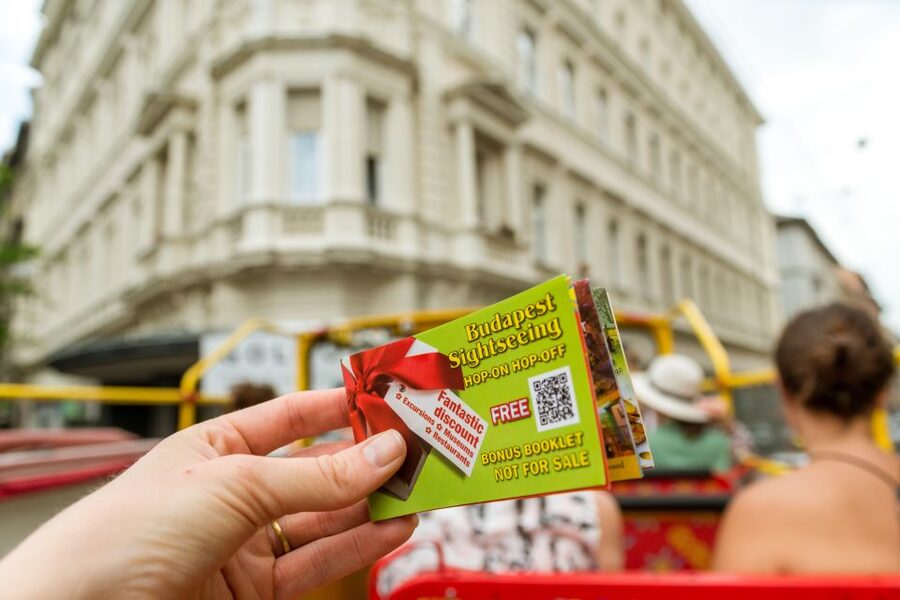
This ticket includes a discount booklet, which can help you stretch your money on popular attractions. The booklet is a real value add if you plan to do at least one paid indoor stop.
There’s also a boat tour mention in the deal, but with an important catch:
- From Wednesday 10th December, the boat tour is no longer included in this ticket.
- If that change applies to your dates, you can buy a boat ticket for HUF 3500 instead of HUF 5000 by showing your bus ticket at the boat departure point.
- Bookings made before that date will be honored and still receive the boat tour.
So here’s my advice: before you settle on a “must-do” Danube plan, check whether the boat is included for your travel day. If you’re aiming for a night view, you can often justify the extra cost because Budapest glows after dark—but make sure it’s actually included with your option.
Practical tips to make the bus smoother (especially in busy seasons)
Hop-on hop-off tours are great until they aren’t. These are the friction points worth planning around:
Traffic and crowding on stops
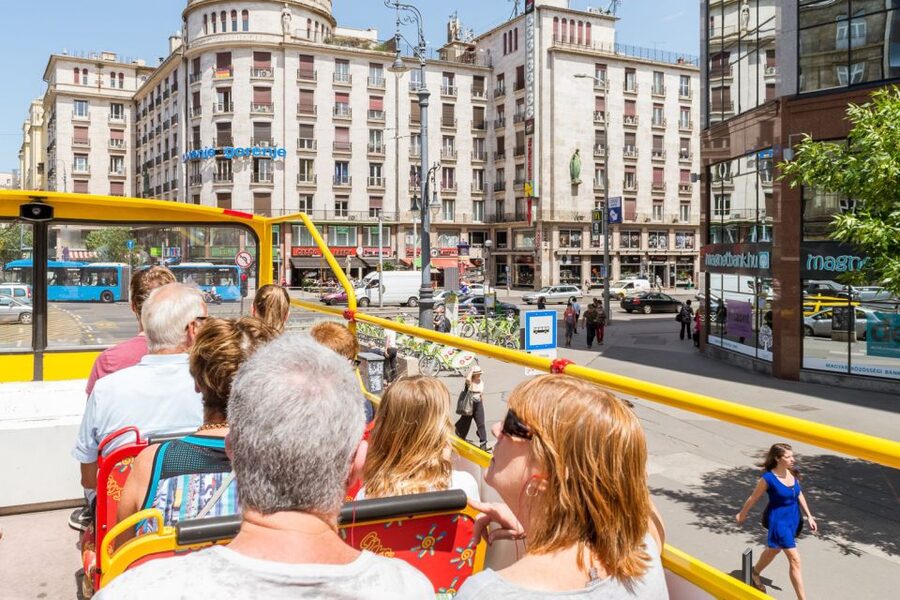
Budapest can get busy. Traffic jams mean your loop may slow down. Crowd levels can also affect how quickly you can board at popular stops like the Basilica, Chain Bridge area, and Parliament-side points.
Use the map aggressively
Some people found that the route map they expected didn’t match the one handed out on paper. Don’t panic. Just treat the printed map as the version to follow for your day, and confirm stop names on arrival.
Plan for the one-way flow
The red route runs as a loop, and you generally want to do stop order in a sensible sequence. If you hop off, do the core sights near that stop, then hop back on—don’t hop off, start a long detour, and then realize you’ll miss your next convenient connection.
Heat, roof status, and comfort
A few people noted variations in bus comfort—some buses had roof coverings and others didn’t, and air-conditioning wasn’t consistent. If you travel in warm months, bring light layers and plan for sun exposure if you’re in an open section.
Keleti stop can be tricky for first-timers
One review mentioned it was hard to find the bus station near Keleti even with guidance. If you’re staying around Keleti, give yourself extra time the first day to locate the stop.
Is this tour worth booking? My decision rule
Book it if:
- You want easy transportation across both Pest and Buda without figuring out transfers every time.
- You like to start with a loop, then spend your time where the city grabbed you.
- You value an included 1-hour guided walk to connect the biggest “walk-only” sights like Shoes on the Danube Bank and Váci Street.
- You’re open to a plan that’s flexible, not perfectly linear.
Skip it if:
- You only need one or two major sights and you hate waiting for buses.
- You plan to spend most of your time deep inside museums and won’t benefit from the route as transportation.
- You’re extremely sensitive to audio quality and crowds at stops.
My bottom line: this is a strong “get organized fast” Budapest option. You’ll come away knowing where everything is, and that makes the rest of your trip easier.
FAQ
What time does the Red Line start and end from Stop 1?
The first departure from Stop 1 is at 9am, and the last departure from Stop 1 is at 5pm.
How often do the buses run?
Buses run every 10 to 20 minutes.
How long is a full Red Line circuit?
The Red Line circuit takes about 90 minutes.
Where does the walking tour meet, and what time does it start?
The walking tour starts every day at 11am from Szent Istvan ter 1, 1051, Hungary.
Is the walking tour narrated, and what language is it in?
Yes. The walking tour is narrated in English only.
What languages are available for the audio guide on the bus?
The audio guide is included in Spanish, Turkish, Chinese, English, Finnish, French, German, Greek, Hebrew, Hungarian, Italian, Japanese, Arabic, Polish, Portuguese, and Russian.
Does the ticket include the Danube boat tour?
Boat tour inclusion changed: from Wednesday 10th December it is no longer included in the ticket. You can buy a boat ticket for HUF 3500 instead of HUF 5000 if you show your bus ticket at the boat departure point.
Is this hop-on hop-off bus wheelchair accessible?
Yes, the buses are wheelchair accessible.