One of Hong Kong’s most interesting morning plans.
This 5-hour Hong Kong New Territories heritage coach tour takes you along the Yuen Long Ping Shan trail and into places most visitors never find on their own, including the ancient Tsui Sing Lau Pagoda and a real walled village scene. I also like the Tai Po Market snack stop, because it turns history into something you can actually taste and walk off afterward.
You’ll get an English-speaking guide, transfers between sites, and door-to-door round-trip pickup from select Kowloon and Hong Kong Island hotels, so the day runs without the usual transport stress. The potential drawback: hotel pickup is limited to certain major hotels, and lunch isn’t included—so you’ll want to plan for an early start and then eat later on your own.
If you want traditional culture with real buildings, not just photos, this is a strong way to spend half a day in Hong Kong’s past while still keeping logistics easy. And if you get a guide like Jo-elle (known for excellent English and humor) or Andy, you’ll probably find the history lands in a way that sticks.
In This Review
- Key highlights worth your attention
- Why the New Territories heritage trail beats the usual Hong Kong stops
- Getting picked up between 7:50 and 8:35: what that convenience really buys you
- Tsui Sing Lau Pagoda: Hong Kong’s exam-success symbol
- Tang Clan Ancestral Hall and Kungting Study Hall: status hidden in the details
- Tang Clan Ancestral Hall (built 1273)
- Kungting Study Hall (1870s)
- Sheung Cheung Wai walled village: what a protective wall tells you
- Tai Po Market snack tasting and the Tai Fu Tai Mansion closer
- Tai Fu Tai Mansion (Sha Tin side)
- Price and logistics: is $144.32 good value?
- Who this tour suits best (and who might not love it)
- The practical way to make the most of your 5 hours
- Should you book Hong Kong Heritage Discovery?
Key highlights worth your attention
- Yuen Long Ping Shan Heritage Trail: a guided route through old New Territories culture
- Tsui Sing Lau Pagoda: Hong Kong’s oldest pagoda, linked to exams and success
- Tang and study halls: look for the design clues that hint at status and craft
- Sheung Cheung Wai walled village: symmetry and green-brick walls that still feel intact
- Tai Po Market snack tasting: street-market flavors beyond takeout shopping
- Small groups on a coach: the tour runs with a maximum of 6 travelers
Why the New Territories heritage trail beats the usual Hong Kong stops
Hong Kong is often sold as skyscrapers, harbor views, and neon nights. This tour changes the angle. You’re heading into the New Territories, where the story feels slower and more grounded—stone buildings, courtyards, village walls, and family halls that were built to last long before tourism was even a concept.
What makes this route especially worth your time is the way it connects themes. The Yuen Long Ping Shan area isn’t just one famous monument. It’s a chain of places tied to families, learning, and local rituals. You start with a pagoda tied to exam success. Then you move into ancestral and study buildings. After that, you see how a walled village was planned for community life and protection. The final stretch brings you back to everyday energy at Tai Po Market before ending at Tai Fu Tai Mansion.
This is also a practical choice if you’re short on time. In about 5 hours, you can see a lot of different “types” of heritage—religious, educational, residential, and marketplace—without having to coordinate buses or worry about getting lost between far-flung neighborhoods.
Getting picked up between 7:50 and 8:35: what that convenience really buys you
The tour starts early. Pickup usually happens between 7:50am and 8:35am from select hotels on Hong Kong Island and Kowloon. Your exact pickup time is confirmed by the operator, and your guide meets you via the pickup list by eye contact or name check.
This matters more than it sounds. In Hong Kong, “simple” DIY plans can turn into multiple legs of transit, plus walking, plus time you didn’t budget. Here, transfers between attractions are included, and you’re traveling with an English-speaking guide throughout the transfers and sightseeing.
A second practical point: the tour uses a mobile ticket, and the operator gives you a final voucher with your pickup time and meeting place. That reduces the guessing game on the morning of your departure.
One more detail that’s good to know: the tour can run as a smaller group on the coach. In at least one instance, the bus had just five passengers with Andy and the driver. That’s not something you can guarantee, but it does suggest you’re not stuck in a cattle line.
Tsui Sing Lau Pagoda: Hong Kong’s exam-success symbol
Your first big stop is Tsui Sing Lau Pagoda, described as Hong Kong’s oldest pagoda. It’s a three-storied green-bricked building believed to have been built in 1486. One look and you’ll notice it’s hexagonal, and it rises about 42 feet (13m) high.
But the interesting part isn’t only the shape. The top floor is dedicated to Fui Shing, often linked to success or failure in exams, plus auspicious Chinese sayings inscribed on each floor. In other words, this place isn’t just architectural. It’s a cultural message: learning, achievement, and hope—wrapped in a public monument.
What to do while you’re there:
- Take a slow look at the floors and inscriptions rather than treating it like a quick snapshot.
- Notice the green brick and the way the structure stacks—pagodas often look “simple” until you study their layers.
A minor consideration: pagoda courtyards can feel busy depending on the day. If you care about photos without crowds, plan to linger patiently rather than rushing.
Tang Clan Ancestral Hall and Kungting Study Hall: status hidden in the details
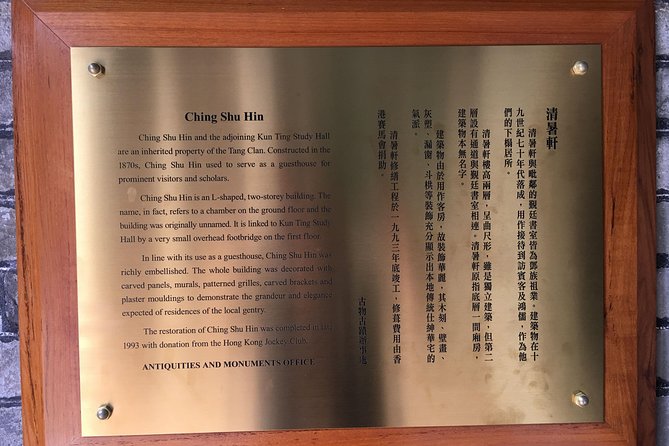
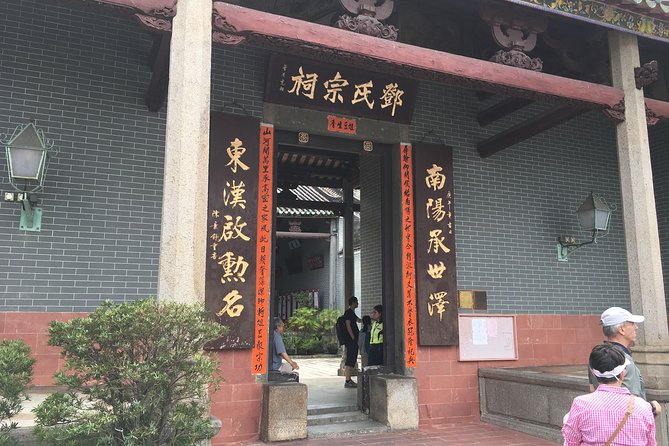
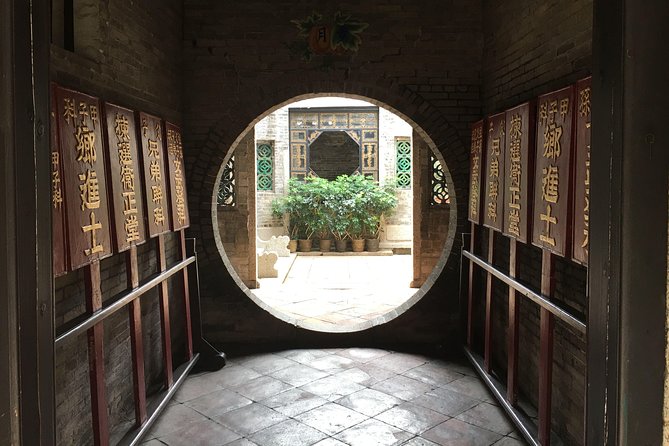
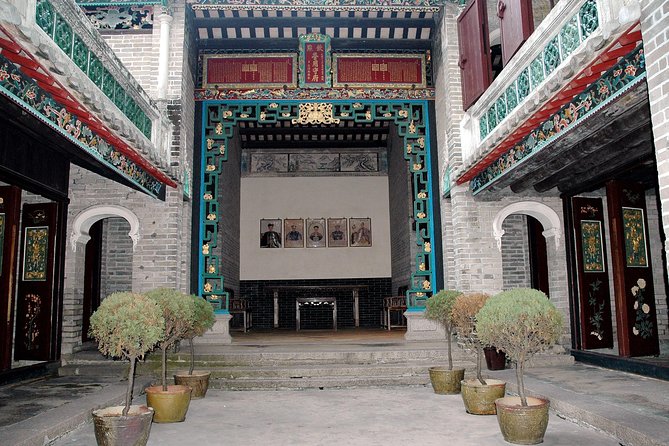
After the pagoda, the tour leans more into family and education. You’ll visit the Tang Clan Ancestral Hall, and later Kungting Study Hall—two stops that help you understand how traditional Chinese families used buildings as both memory and instruction.
Tang Clan Ancestral Hall (built 1273)
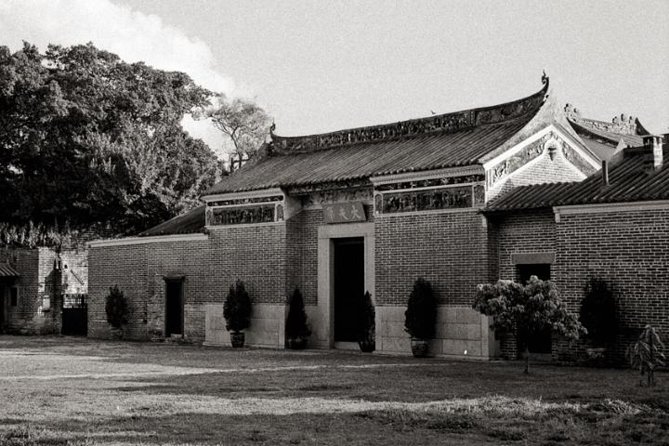
The Tang ancestral hall dates to 1273 and is known for being a magnificent three-hall structure with two internal courtyards. One detail I’d watch for: the pathway elevation in the courtyard. This is explained as a clue that one of the Tang clansmen held a high-ranking position in the imperial government.
Even if you don’t know all the historical terms, this kind of architectural “status coding” is exactly why guided heritage tours are valuable. You can walk past an elevated path on your own and never realize it was intentional.
Kungting Study Hall (1870s)
Next is Kungting Study Hall, built in the 1870s and used both as an ancestral hall and a place of study. It’s a two-hall building with an enclosed courtyard, and the standout features are finely carved granite columns and granite block basework along the facade.
Inside, the design reflects the craftsmanship of that era. The tour format makes this easier: you’re not left alone to interpret what you’re seeing. An experienced guide can point out what the building is trying to communicate—family legacy on one side, learning on the other.
Practical tip: these are stone-heavy places. If it’s a hot or humid day (common in Hong Kong), slow down your pace and take breaks where you can.
Sheung Cheung Wai walled village: what a protective wall tells you
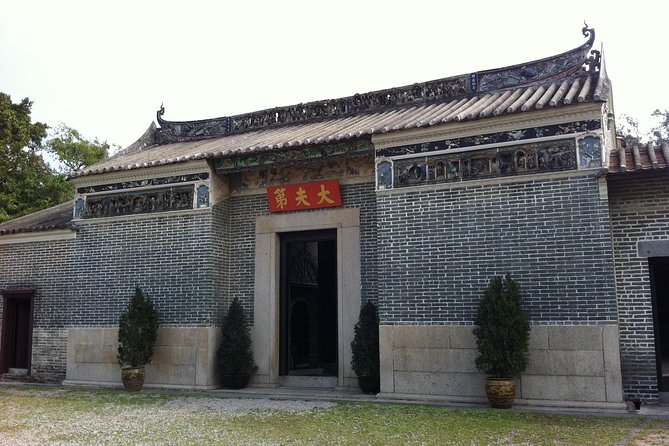
Then you head to Sheung Cheung Wai, a 200-year-old walled village. The description is straightforward but powerful: rows of symmetrical houses enclosed by a green brick wall, with the gatehouse, shrines, and some old houses still standing.
Part of the wall may be missing, but enough remains to give you a clear feel for what a traditional Chinese walled village was meant to do. Those walls weren’t decorative. They were practical. You can often read the priorities of a community right in the built form: controlled access, protected living space, and a layout that emphasizes order.
What I think makes this stop meaningful on a guided tour: you’ll see more than “old houses.” You’ll understand the logic. Even brief explanations about gates and shrines change how you look at the same view.
If you like photography, this is one of the better times on the day. Symmetry plus walls means the angles are naturally strong.
Tai Po Market snack tasting and the Tai Fu Tai Mansion closer
Half-day tours usually stop at a market and then rush you back out. Here, you get Tai Po Market, and you also get traditional local snack tasting included.
Tai Po Market used to be the trading ground for foods and goods around the New Territories. Now it’s a thriving food market with a street lined with vendors. You’ll likely run into fresh vegetables, cured meats, dried seafood, and locally made candies—all the usual ingredients behind Hong Kong flavors, but shown in a market setting rather than a supermarket aisle.
The snack tasting isn’t described as a full meal, but it’s a real win for two reasons:
1) it gives you a gentle entry into local taste without requiring you to gamble on what to pick, and
2) it turns the heritage tour into something you can carry with you for the rest of the day.
Tai Fu Tai Mansion (Sha Tin side)
The tour then finishes at Tai Fu Tai Mansion, located in Sha Tin to the east of Mai Po. It’s thought to have been built in the 1870s by Man Chung-Luen, a successful merchant and well-known philanthropist.
This mansion is described as a fine example of a traditional Chinese dwelling of the scholar-gentry class, and one of the most elegant buildings throughout the territory. It was gazetted as a historic building in 1987 and renovated, with work completed in 1988.
If you’re wondering why your day ends here: the mansion helps you round out the theme. You saw a pagoda for aspirations, halls for family and learning, a village for community life, and now you get the “home base” version of status and refinement.
Price and logistics: is $144.32 good value?
At $144.32 per person for about 5 hours, the cost only makes sense when you look at what’s included. Here’s the value math I see:
- You get pickup and round-trip transfers from select hotels (not just a meeting point).
- You get an English-speaking guide for the whole sightseeing portion and transfers.
- You get transportation between multiple heritage sites that are not close together.
- You get traditional snack tasting at Tai Po Market.
If you tried to DIY this, you’d still pay for transit and you’d spend time figuring out routes and sequencing. Time in Hong Kong is expensive in its own way, especially when you’re doing a half-day.
Two trade-offs to keep in mind:
- Lunch isn’t included, so you’ll need a plan for afterward.
- Pickup is not available from the airport, railway station, cruise terminal, or from hotels in the New Territories (including Lantau Island). If your hotel is outside the pickup list, you might have to make your own way to a departure point.
My take: this is good value if you’re staying in the pickup zones and you want a guided cultural day without the DIY workload.
Who this tour suits best (and who might not love it)
This experience fits you well if:
- You want traditional culture in the New Territories without stitching together transit steps
- You like heritage buildings and want someone to explain the design clues
- You prefer a small group day (maximum of 6 travelers)
It might feel less ideal if:
- You’re set on going at your own pace all day long
- You need a lunch included in the ticket price
- Your hotel is outside the pickup list and you don’t want to deal with meeting point logistics
Also, because it depends on good weather, plan for the fact that Hong Kong can change fast. If it’s poor weather, you’ll be offered a different date or a full refund.
The practical way to make the most of your 5 hours
If you book this, you’ll get more out of it if you treat it like a structured tour, not a sightseeing checklist.
A few simple moves help:
- Go in with comfortable walking shoes. You’ll be outdoors around villages and market areas, and you’ll be moving between heritage stops.
- Bring water and something light for later. Snack tasting is included, but lunch and dinner are not.
- Be ready for questions. This kind of tour works best when you listen and then ask about what you notice—especially with pagodas, courtyards, and carved stone details.
If you want to linger longer in Tai Po Market, there’s an option to leave the group there for the rest of the day. That needs approval in advance, and you’ll want your guide’s cellphone in case of urgent coordination.
Should you book Hong Kong Heritage Discovery?
I’d book it if you want a half-day that feels authentically Hong Kong in a quieter way—built heritage, local market life, and guided interpretation that makes the architecture mean something.
I’d skip it if your main priority is city skylines or if you’re staying outside the pickup zone and don’t want to add your own transit time. Also, if you hate early starts, the morning pickup window may not make you happy.
If you’re in the right location and you’re comfortable with a timed tour, this one is a smart way to see the New Territories without turning your day into a transportation project.