
One-hour and you get your bearings fast. This Hanoi city bus tour is built for first-timers: a double-decker ride that strings together big-name landmarks, with commentary in multiple languages and plenty of window time to take in the shape of the city.
I like two things most: the panorama view from the top deck around Ba Dinh Square and the Ho Chi Minh Complex area, and the sheer convenience value at about $7 for a compact sweep of more than 20 famous stops. The main catch is that despite the Hop on Hop off name, it’s effectively a non-stop loop: if you get off (notably at Hanoi Opera House), you can’t re-board.
In This Review
- Key points before you ride
- A 1-hour Hanoi overview that fits real schedules
- Where the bus leaves from and how the loop really works
- Ba Dinh Square panorama and Ho Chi Minh Complex from the top deck
- Hoan Kiem Lake and the Old Quarter vibe from the road
- Saint Joseph Cathedral, churches, and the story in architecture
- Temples and pagodas: what to notice as you roll past
- Imperial Citadel of Thang Long and the big historical anchors
- Temple of Literature and museums you can plan around
- Opera House stop: a natural place to break away
- Audio guide in 8 languages plus free extras that reduce friction
- Price and value: why $7 can work (and when it won’t)
- Who should book this Hanoi city bus tour
- FAQ
- How long is the Hanoi City Hop on Hop off bus tour?
- How often do the buses run?
- Where is the main meeting point?
- Do I need to go to Dong Kinh Nghia Thuc Square every day?
- What languages are included for the audio guide?
- Is this a true hop-on hop-off tour where I can re-board after getting off?
- What landmarks does the bus route include?
- Are entrance fees included for attractions?
- What is included in the ticket besides the bus ride?
- Should you book this Hanoi city bus tour?
Key points before you ride
- 1-hour loop with 30-minute frequency: it’s easy to fit even if your day is already packed
- Top-deck views of Ba Dinh and Ho Chi Minh Complex: great for photos and orientation
- Audio guide in 8 languages: English, French, German, Spanish, Russian, Japanese, Korean, and Vietnamese
- Major landmarks along the route: from Hoan Kiem Lake to Temple of Literature, Hoa Lo Prison, and more
- Free comfort extras: water, conical hat, rain coat, city map, and free Wi-Fi
- One-and-done style: if you step off at the Opera House, plan your next stop on foot
A 1-hour Hanoi overview that fits real schedules

Hanoi can feel like a lot on day one: lakes, temples, colonial-era buildings, big memorial spaces, and busy streets all at once. This bus tour is designed for the practical traveler who wants a fast “map in motion.” You stay on for about an hour as the route threads together the city’s most visited sites.
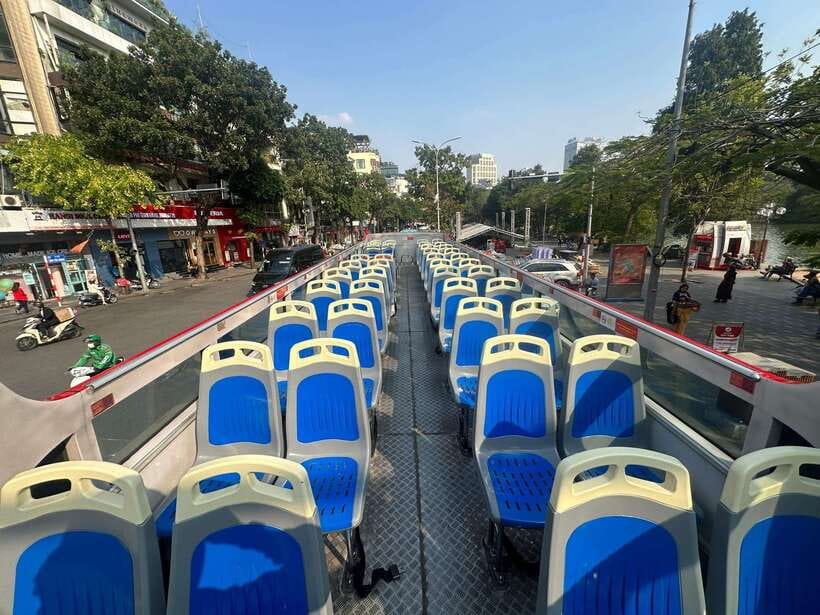
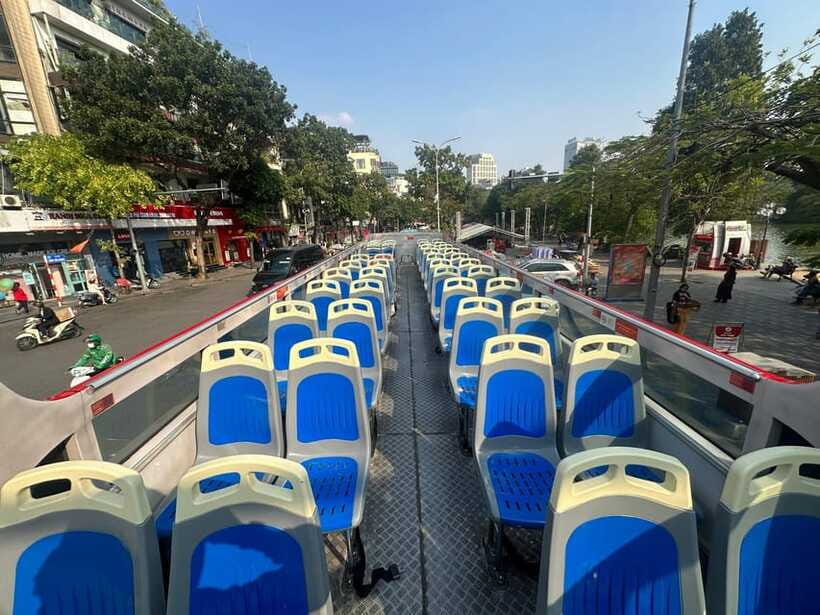
You’ll ride on a double-decker bus with open-top sightseeing from higher seating (when weather and setup allow). That matters because Hanoi’s best first-impression views often come from above: roads, lake edges, large squares, and major facades look different from a sidewalk vantage point.
The commentary is part of the value, too. You get an audio guide tied to what you’re seeing, and it’s available in eight languages. So even if you don’t speak Vietnamese, you can follow along without relying on guesswork or a fast-reading guidebook.
Where the bus leaves from and how the loop really works

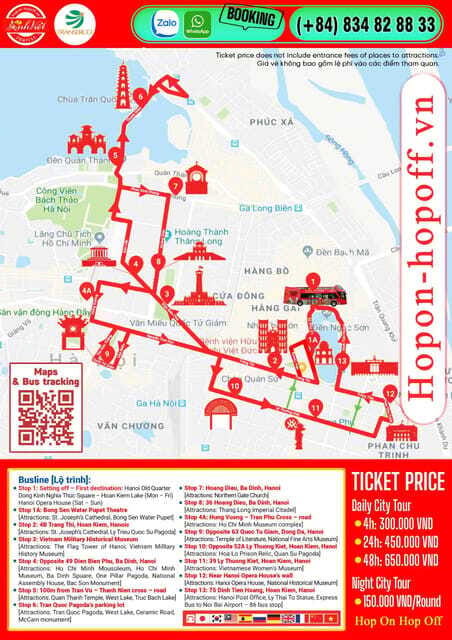
The meeting point is at Dong Kinh Nghia Thuc Square, 7 Dinh Tien Hoang. On Monday through Friday, you’ll use that location up to 7:00 pm.
On Friday, Saturday, and Sunday, there’s also a pickup/start option at Hanoi Opera House from 7:30 pm. When you arrive, look for the red double-decker bus Hanoi City tour ticket booth.
A couple of details change how you plan your time:
- The full loop lasts about 1 hour.
- It’s not set up as true unlimited hop-on hop-off. If you get off, you can’t get back on again.
That means you should treat it like a guided ride with a main drop point. The tour is designed so you can enjoy the views from the bus and then choose where you want to continue after the Opera House stop.
Tip: keep your ticket handy. Staff ask to see your ticket or mobile ticket when you board.
Ba Dinh Square panorama and Ho Chi Minh Complex from the top deck

If you’re only going to remember one “wow moment” from this tour, make it the bus pass and viewpoint around Ba Dinh Square and the Ho Chi Minh Complex. These are large, formal spaces, and from the upper deck you can really see the scale and layout.
From inside the bus, the audio guide helps connect what you’re looking at to the bigger story. Even if you don’t stop for museum time or memorial entry (entrance fees aren’t included), you still get the orientation that makes later visits easier.
Practical photo note: memorial areas can be bright and high-contrast. A hat and shade help, and the tour provides a rain coat and a conical hat so you’re less likely to scramble for weather protection.
Hoan Kiem Lake and the Old Quarter vibe from the road
One reason this route works is that it doesn’t only aim at grand monuments. It also threads through central Hanoi where you feel the daily rhythm of the city.
The bus passes Hoan Kiem Lake, which is one of Hanoi’s easiest reference points. Seeing it from the bus gives you a quick mental picture: where the lake sits, how neighborhoods connect around it, and how busy the streets are close to the center.
Then there’s the Hanoi Old Quarter, where the energy is hard to miss even from a moving vehicle. You might not have time to wander alley by alley during a one-hour loop, but you’ll understand what you want to explore later. If your schedule is tight, this kind of “first pass” is often more useful than rushing into a single temple and missing the bigger map.
Saint Joseph Cathedral, churches, and the story in architecture

This tour includes major religious landmarks along the route, which gives you a mini course in Hanoi’s architectural mix.
You’ll pass Saint Joseph Cathedral and Cua Bac Church. From the bus, look at the facades and how these buildings sit among surrounding streets. They’re not just pretty stops; they help explain how Hanoi’s identity has layers—different periods, different influences, different styles living side by side.
Even if you only glance through windows, you’ll likely find the audio guide helps you connect what you see to the purpose of each site. That’s one of the strongest reasons to do this early in your stay: it gives context before you start choosing which places to enter.
Temples and pagodas: what to notice as you roll past

Hanoi isn’t only about buildings you can photograph. It’s also about places you can sense through their placement and design.
On this route you’ll pass Quan Thanh Temple and Tran Quoc Pagoda. Pagodas and temples are easier to appreciate when you understand the “why” behind their siting—often near water, along key routes, or in areas that function as spiritual anchors.
From a bus you won’t get long stays, so your job is simpler: observe the details quickly. Note roof shapes, entrances, and how the surrounding roads flow toward the site. When you later return on your own, you’ll know where to focus your time.
Imperial Citadel of Thang Long and the big historical anchors

For history lovers, the highlight is the pass around the Imperial Citadel of Thang Long and the area connected with the broader legacy of old Hanoi. Even without stepping inside (entrance fees aren’t included), seeing it from the route helps you understand the city’s center of gravity—how modern streets relate to older power and settlement patterns.
One smart way to use this bus ride is to let it set your priorities. After the loop, you’ll know which sites you want to research further or revisit with tickets and time.
If you’re wondering whether the audio guide is worth it, it helps most on these historical segments. Big names can feel abstract unless you connect them to what’s happening in the city around them.
Temple of Literature and museums you can plan around

You’ll also pass Temple of Literature and major museums including Hoa Lo Prison and the Vietnam Women’s Museum.
This is where I think the tour becomes practical rather than just sightseeing. You’re not paying for museum entry on the bus ticket, but you’re learning what each place is before you commit your time later. Hoa Lo Prison, for example, is the kind of site many people want to do carefully. Knowing where it sits and how it fits into your route can save you from backtracking.
Temple of Literature is similar: it’s a place people often want to enter rather than just look at from outside. On a one-hour loop, you’re mostly getting location and orientation, so plan for a follow-up if it’s on your must-do list.
Opera House stop: a natural place to break away
This tour has a named moment: get off the bus at Hanoi Opera House. Since the loop is not set up for true hop-on hop-off freedom, this is likely the point where you decide to continue on foot or move to your next booked activity.
If your goal is a fast overview, you can simply enjoy the ride and then disembark at the Opera House area as a convenient central location. If your goal is deeper exploration, use the loop to learn what you want to revisit and how to get back to it later.
Remember the key rule: if you leave the bus, you can’t get back on again. So have your plan ready before the Opera House stop.
Audio guide in 8 languages plus free extras that reduce friction
The audio guide is one of the best features here. You get commentary in English, French, German, Spanish, Russian, Japanese, Korean, and Vietnamese. That’s a big deal for Hanoi because street signs and history can be tough to decode quickly when you’re tired or moving between sites.
The included extras also make the tour feel more like a low-stress city starter kit:
- free water
- a conical hat
- a rain coat
- a city map
- free Wi-Fi
- bus insurance
These items sound small, but they matter when you’re between stops and weather shifts. Hanoi can go from dry to wet fast, and having a rain coat ready means you don’t delay your day to hunt one down.
Price and value: why $7 can work (and when it won’t)
At around $7 per person, this tour is priced like an orientation service, not a full-day guided program. That’s exactly how I’d think about it.
You’re buying:
- transportation via a double-decker bus for about one hour
- a structured route that hits major landmarks
- an audio guide in multiple languages
- practical freebies that keep the trip comfortable
You’re not buying:
- entrance tickets
- food or drinks
- hotel pickup/drop-off
- tourism insurance (you’d want your own plan for that)
So when is it a smart buy? If you have a short stay, you want to see Hanoi’s layout quickly, and you’re happy to do deeper visits on separate outings later. If you want to spend hours inside museums and memorial sites the same day, this bus alone won’t satisfy you.
Who should book this Hanoi city bus tour
This is a strong match for:
- first-time visitors who need orientation fast
- travelers who want to see a lot without committing to long walks between distant sites
- anyone who benefits from audio commentary instead of reading on the move
- couples, solo travelers, and families who want a simple plan with included comfort items
It’s less ideal if:
- you want lots of time at each landmark during this one hour
- your plan depends on getting on and off repeatedly throughout the route
- you dislike non-stop rides and would rather control every stop yourself
If you like building a personal itinerary, this tour gives you the raw material. Then you decide what deserves your extra time.
FAQ
How long is the Hanoi City Hop on Hop off bus tour?
The tour lasts about 1 hour for the full loop.
How often do the buses run?
The frequency is every 30 minutes.
Where is the main meeting point?
It is at Dong Kinh Nghia Thuc Square, 7 Dinh Tien Hoang.
Do I need to go to Dong Kinh Nghia Thuc Square every day?
No. On Friday, Saturday, and Sunday, there is pickup at Hanoi Opera House from 7:30 pm.
What languages are included for the audio guide?
The audio guide is available in English, French, German, Spanish, Russian, Japanese, Korean, and Vietnamese.
Is this a true hop-on hop-off tour where I can re-board after getting off?
No. It operates as a non-stop loop. If you get off the bus, you are unable to get on again.
What landmarks does the bus route include?
The bus passes many major sites such as Hoan Kiem Lake, Saint Joseph Cathedral, Hanoi Flag Pole, Ho Chi Minh Mausoleum, Quan Thanh Temple, Tran Quoc Pagoda, Cua Bac Church, Imperial Citadel of Thang Long, Temple of Literature, Hoa Lo Prison, Vietnam Women’s Museum, and Hanoi Opera House.
Are entrance fees included for attractions?
No. Entrance fees are not included.
What is included in the ticket besides the bus ride?
The ticket includes a city map, free water, a conical hat, a rain coat, free Wi-Fi, an audio guide, and insurance on the bus.
Should you book this Hanoi city bus tour?
Yes, if you want a cheap, fast way to see Hanoi’s biggest landmarks and come away with a clear sense of where things are. The biggest draw for me is the combo of major-site coverage plus an audio guide in 8 languages, all within a tight one-hour window.
Skip it if your idea of sightseeing is lots of time at each stop or repeated hop-on hopping. Also, plan on paying entrance fees separately if any museum or historic site is on your must-do list.