First impressions count, and this bus helps you get bearings fast. I love the hop-on hop-off freedom (ride the full loop or hop off for one sight, then catch the next bus about every 30 minutes). I also love that the onboard audio commentary comes in 13 languages with headphones, so you’re not guessing what you’re seeing. One thing to watch: audio quality and headset access can vary, and some stops can mean waits in the sun.
For cruise days or short Athens layovers, this is a smart way to cover a lot of ground without planning every turn. The ticket is about value-per-stare-out-the-window time: you’re buying a flexible pass (24 or 48 hours) plus the route network, not museum entry.
You’ll choose where you start—Syntagma Square, Piraeus Cruise Terminal, or the Acropolis area (for the Beach Riviera line, April through October only)—and then you can switch routes at the interchange near the Acropolis & Parthenon area.
In This Review
- Key things I’d focus on before you board
- Choosing the right route: Athens vs Piraeus vs Beach Riviera
- Where you start really matters: Syntagma, Piraeus Terminal, Acropolis area
- How the hop-on loop works on a tight schedule
- Stop-by-stop Athens route: from Syntagma to Monastiraki and beyond
- Piraeus route: cruise-terminal friendly, with port and maritime atmosphere
- Beach Riviera route: seasonal coast time without the bus wrangling
- Price and value: why this $26.43 ticket can be a smart move
- Audio guide and headphones: getting clear sound in a noisy city
- Making the day work: limited time, cruise days, and transfer anxiety
- Where it can fall short: noise, long stop waits, and finding the right bus
- Should you book this Athens and Piraeus hop-on hop-off bus tour?
- FAQ
- How long is the Athens and Piraeus hop-on hop-off bus tour?
- Where do I board for each route?
- Which routes run all year, and which are seasonal?
- Is audio included, and in how many languages?
- Is entry to attractions included?
- How do I use the voucher on the day of the tour?
- Can I cancel for a full refund?
Key things I’d focus on before you board
- Up to three routes on the same idea: Athens plus Piraeus and, seasonally, the Beach/Riviera route.
- Audio guide in 13 languages with headphones: great when you want history without stopping.
- Route interchange near the Acropolis & Parthenon: a practical way to combine Athens sights with the port route.
- Buses every ~30 minutes: enough rhythm to keep your day flexible.
- Seasonal coverage for coastal areas: Piraeus/Beach/Riviera run April–October, while Athens runs most of the year.
- Watch for the usual hop-on issues: audio clarity, finding the correct stop, and longer waits at some places.
Choosing the right route: Athens vs Piraeus vs Beach Riviera
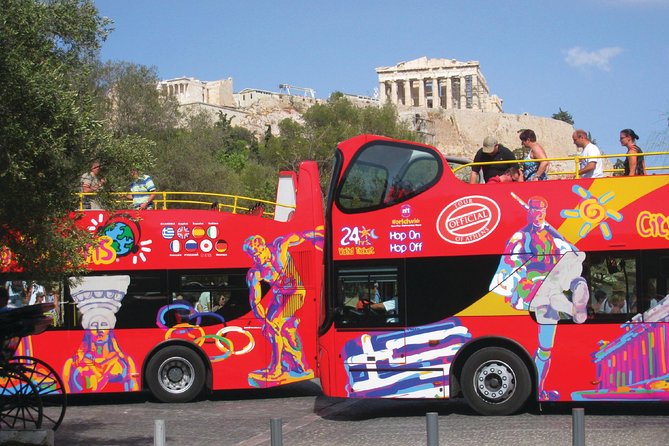
This tour isn’t one single line. It’s really a network of circuits that you can ride in pieces, then stitch together.
The Athens route is the “year-round backbone.” It runs all year except 17th November, 25th December, and 1st January. Departures start early (first at 8:30am) and the last departures are typically around 4:30pm, with buses coming every 20–30 minutes and a loop time of about 90 minutes.
The Piraeus route is the port-and-city mix. It’s scheduled around a couple of daily departure windows (11am and 3pm), and the ride time is listed as about 80 minutes. This one also makes the most sense if you’re arriving by ship and want to get from the docks to a broader view of Athens.
Then there’s the Beach Riviera route, which is seasonal (April through October only). It runs fewer times per day (11am, 1pm, 3pm), and the loop time is longer (about 110 minutes). If you’re in Athens during warmer months and you want the coast vibe, this is the route to build around.
Where you start really matters: Syntagma, Piraeus Terminal, Acropolis area
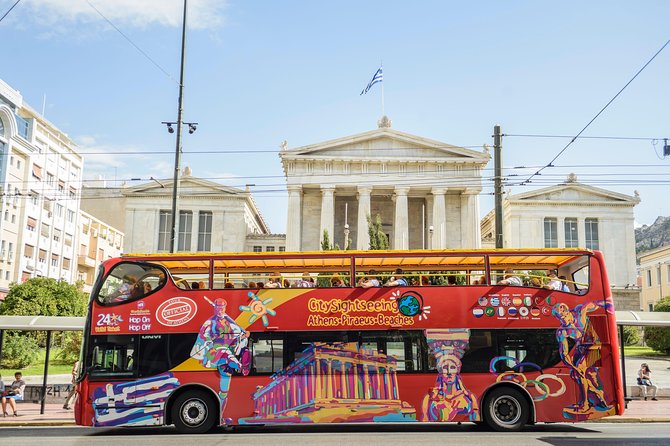
Your start point changes your day more than you’d think.
If you start on the Athens route, you board from Syntagma Square (Athens Line). This puts you in the heart of the city, close to the Parliament / National Gardens area that shows up again on the route.
If you’re on a cruise, your life is easier if you board from the Piraeus Cruise Terminal area. The tour data says that for cruise passengers, the nearest joining points (when you’ve chosen the Piraeus route) are stops 4, 5, and 6 on the Piraeus circuit. Those stops include the cruise terminals A & B area, so you’re not doing a long back-and-forth just to get the bus.
For the Beach Riviera line, you join near the Acropolis/Plaka area and it only operates April through October. That’s useful if you want to pair Acropolis viewpoints first, then spend your time later on beaches and southern suburbs.
Tip: choose your route based on your arrival window. The Piraeus and Beach/Riviera circuits don’t run all day like the Athens line does.
How the hop-on loop works on a tight schedule
The big selling point is simple: once you’re on, you can hop off and hop back on as often as you like.
Buses are listed as running about every 30 minutes, and the Athens line is even a bit more frequent (every 20–30 minutes). That spacing matters because Athens traffic can slow things down. With a frequent bus rhythm, you can recover if you miss your moment to board.
Your ticket options are 24 or 48 hours depending on what you select. That’s not just “more time.” It’s a buffer for reality: late buses, time spent at a museum, or the simple fact you’ll want one extra hour near Plaka or Monastiraki.
One practical detail: the voucher you get is not the final ticket. The data is clear that you must redeem the electronic voucher by an agent at the stop or on the bus before you board. After that redemption, you need to keep the printed paper ticket for the entire duration because electronic vouchers can’t be used again after redemption.
Stop-by-stop Athens route: from Syntagma to Monastiraki and beyond
Think of the Athens route as your “big highlights sampler.” It loops through central Athens and the major museum zones, then back toward the older shopping areas.
Syntagma Square (Stop 1)
This is your anchor. It’s a strong starting point because you can orient yourself quickly around the city center. If you only have one hop-off early in the day, Syntagma is where you’ll want to be.
Melina Mercouri Monument (Stop 2) – Acropolis / Plaka
This stop is all about the Acropolis/Plaka area. If your goal is photos and an easy walk into the neighborhood, this is a natural first hop. It’s also handy because the tour later gives you a second look at this interchange zone.
Chatzichristou 6A (Stop 3) – Acropolis Museum
This is the museum stop. If you want the museum break without having to research how to get there, hop off here. The downside is that museums take time, and if you hop off for too long, you’ll feel rushed trying to catch the next bus back.
Kiosk (Stop 4) – Acropolis & Parthenon interchange
This is the key transfer point. The data labels it as an interchange with the Piraeus route, which makes it useful if you’re combining port sights with Acropolis views. If you’re switching routes, build in a little extra time so you don’t turn a simple transfer into a sprint.
Melina Mercouri Monument (Stop 5) – Temple of Zeus
This stop keeps you in the Acropolis broader area zone. It’s a good option when you want another viewpoint angle rather than a full second museum plan.
Syntagma Square (Stop 6) – Parliament / National Gardens
This is your return toward the city center. If you want a break from the walking loop, this stop is a good “reset” location.
Leof. Vasilissis Sofias 642 (Stop 7) – The Four Museums
This sounds like a museum cluster stop, and that’s exactly why it helps. You can pick one museum to prioritize and skip the rest. The tradeoff is heat and time: if you hop off, plan your next hop based on how long you actually want to be indoors.
Leof. Vasileos Alexandrou 14 (Stop 8) – National Gallery
Another major art stop. It’s useful if you know you want the gallery, but if art isn’t your thing, you may prefer hopping off earlier for streets like Plaka and later for Monastiraki.
George Karaiskakis Statue (Stop 9) – Ancient Olympic Stadium
This is the stadium area stop. It’s a nice option for exterior views and quick photo time, and it can also fit well if you want to mix sightseeing styles (museum, then sports-era site, then shopping).
Oμόνοια 118 (Stop 10) – National Library
This one is more “institutional Athens.” If you’re trying to learn the city layout and where big cultural buildings sit, it’s useful. If you’re mainly hunting for views and neighborhoods, you might treat this as a pass-through unless you’re specifically interested.
28is Oktovriou 53 (Stop 11) – National Archaeological Museum
This is a strong museum target. The benefit is straightforward: the bus brings you there without guessing transportation. The drawback is the same as any museum-heavy day—time can disappear fast.
Pl. Omonias 3 (Stop 12) – Omonia Square
Omonia is a useful central marker. It’s a good stop if you need to regroup, grab water, or plan your next hop.
ATM Alpha Bank (Stop 13) – Karaiskaki Square
This is another practical central stop. If you want to keep moving and avoid long stays, it’s where you can hop off briefly.
Ermou 137 (Stop 14) – Monastiraki Square
This is one of the highlights for walking and wandering. If you want an evening vibe or souvenir browsing, Monastiraki is exactly the kind of stop that turns a bus tour into a real day out.
Town Hall / Kotzia Square (Stop 15)
This ties into the city’s older center feel. If you’re finishing your loop and want to walk a little, this stop works well as a final “stroll into the evening” point.
Piraeus route: cruise-terminal friendly, with port and maritime atmosphere
The Piraeus circuit is where you go when Athens isn’t just landmarks—it’s also the working harbor side.
Isalos.net (Stop 1) – Pantion University
A quick campus-area pass. This can be handy if you want to see more than just monuments, but it’s not usually a “must stay” stop unless you have a reason.
Lisikratous 1 (Stop 2) – Niarchos Foundation
Another landmark-name stop. If architecture and cultural buildings are your thing, it’s an easy hop.
Sotiros Dios 15 (Stop 3) – Municipal Theatre
This is the arts-and-staging type stop. Great if you want that broader city look, less great if you’re trying to maximize time at the port itself.
Telōneio (Stop 4) – Cruise Terminals A & B
This is crucial for cruise passengers. It’s one of the nearest points to join, and it also sets you up for a day that doesn’t rely on taxis.
Akti Miaouli 238 (Stop 5) – Lions Gate
A named sight that gives the port-side area some classic texture. It’s a good “short walk, photo, back on bus” stop.
The Nelson Exhibition (Stop 6) – Archaeological Museum of Piraeus
This is your museum option on the port side. If you prefer smaller, more local museums over giant ones, this stop can feel like a smart swap.
Akti Kountouriotou 13 (Stop 7) – Votsalakia Beach
A beach stop on the port route. Since it’s part of the Piraeus line, it can be a nice break from city sights. Just remember: beaches are time sinks if you’re not careful.
Leof. Al. Papanastasiou 68 (Stop 8) – Mikrolimano Harbour
This is one of the more “hang around” type stops because harbors tend to pull you into walking. If you have a limited time window, use it for a short reset and keep an eye on next-bus timing.
Leof. Andrea Siggrou 387 (Stop 10) – Grand Hyatt & Intercontinental
A hotel-area stop. It’s useful as a central marker, especially if you’re meeting someone or want an easy reference point.
Kiosk (interchange) near Acropolis & Parthenon
The tour links back toward the Acropolis interchange zone. This is the moment when you can pivot your plan: either stay in the Athens highlights area or return to port-route time.
On paper, this circuit is great for people who want a split day: Acropolis viewpoints plus a real sense of Piraeus. In practice, your day depends on how the buses line up at transfers.
Beach Riviera route: seasonal coast time without the bus wrangling
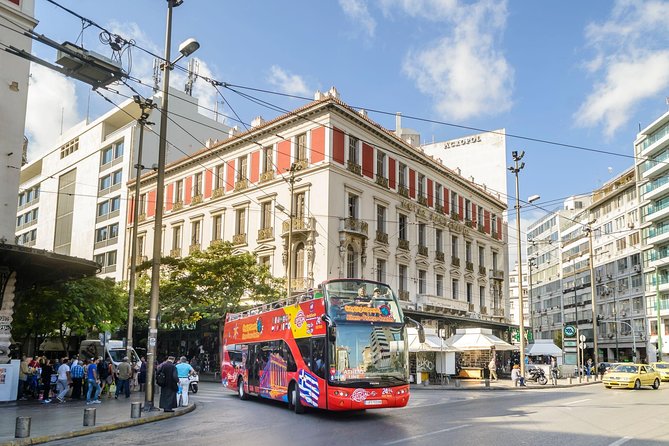
If you’re visiting Athens in the warmer months, this route is a strong add-on because it brings you toward beaches and coastal neighborhoods.
Melina Mercouri Monument (Stop 1) – Acropolis / Plaka
You start in the Acropolis/Plaka orbit, so you can get those core sights first.
Then it shifts toward cultural anchors and coastal stops, including:
Niarchos Foundation (Stop 3), Trokantero (Stop 4) – Faliro / Flisvos, and Edem (Stop 5). These are the kind of stops that let you taste the city beyond the postcard layer.
Beach time becomes more obvious with stops like:
Agios Kosmas Beach (Stop 6), Glyfada Town (Stop 15), Golf (Stop 16), Kalamaki (Stop 18), and additional seaside areas around Poseidon Hotel (Stop 19).
The route also lists hotel and landmark nodes such as:
Divani Apollon (Stop 11) and Athens Astir Palace Beach Resort (Stop 12), plus Vouliagmeni Lake (Stop 12 on the Piraeus-style list appears as Limnē / Vouliagmeni Lake on the Beach Riviera section). If you want a scenic coastal sampler, those named areas help you decide where it’s worth getting off.
Practical caution: because Beach Riviera is only April through October and runs only a few departures per day, you can’t treat it like an always-available option. Pick it as your main “theme,” then use the Athens route for flexibility.
Price and value: why this $26.43 ticket can be a smart move
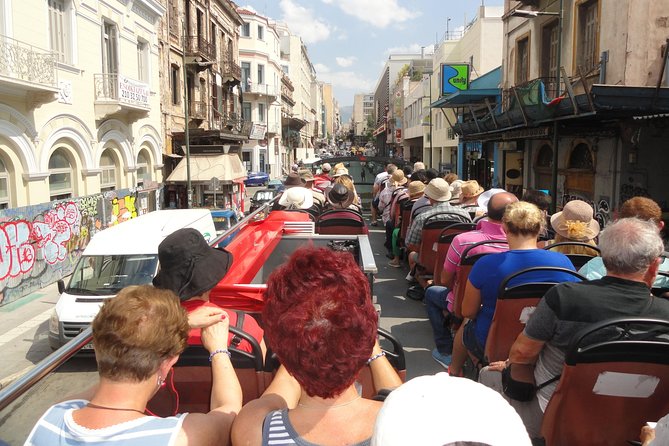
At $26.43 per person, you’re buying a pass that can cover up to three routes (depending on which option you select) with 24 or 48 hours. That’s usually good value in Athens because sights are spread out and taxis add up fast—especially if you’re trying to do more than one area in a day.
What’s included is also practical for the price: free Wi‑Fi, audio guide commentary in 13 languages, and stops near major sights. You also get a free glass of Greek bar listed in the inclusions. Just know that in real life, it may not be obvious how that works on the first try, so ask staff onboard.
What’s not included is equally important. You’re not paying for entry to attractions, and you’re not getting food and drinks (unless specified by that free drink). So this is a transport-and-narration ticket, not a museum pass.
One thing I’d take seriously: value works best when you actually use the hop-on feature. If you stay seated for the whole ride with no planned stops, it can feel like you paid for a bus loop rather than sightseeing help.
Audio guide and headphones: getting clear sound in a noisy city
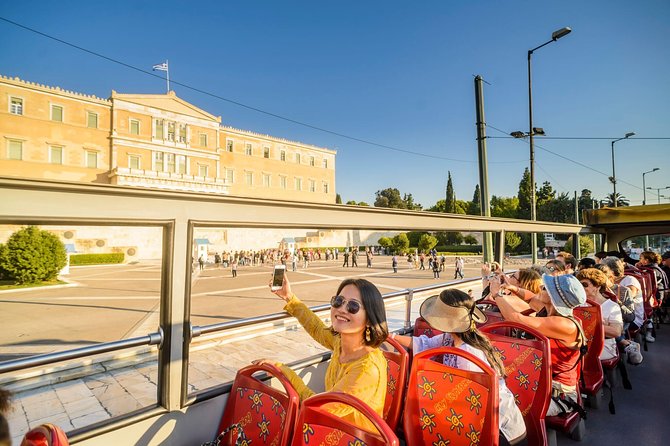
The tour includes audio guide commentary in 13 languages and headphones. That’s exactly what you want on an open-top bus, where you can’t always hear street-level explanations.
The reality is more mixed. Some people report the sound was hard to understand, with music taking over between stops. Others mention static or poor volume. A few even described headphone jack placement or cable length issues that made it harder to plug in from certain seats.
Here’s the practical way to reduce frustration:
- Before settling in, check that you can reach the headphone jack comfortably.
- If the audio sounds weak or distorted, adjust your headset position right away and flag a staff member.
- If you’re sensitive to sound, consider bringing your own backup way to listen—but only if you already travel with headphones that work with your devices.
Also, open-top buses mean wind and city noise are part of the deal. You’re here to learn and look, not to expect a quiet lecture.
Making the day work: limited time, cruise days, and transfer anxiety
This tour is built for flexible timing, but your schedule still matters.
For cruise passengers, the big advantage is the proximity of stops near Cruise Terminals A & B on the Piraeus line. You don’t need hotel pickup or drop-off. You join at the nearest stops, ride out, and then return using the same terminal area.
Where people get burned is timing stress. If your ship arrival is late, you may have less time before the Athens line’s last departures. And if you miss a bus at a transfer point, you could end up waiting in the wrong place at the wrong moment.
My best advice for a tight port day:
- Pick one “core” area and one “bonus” stop. For many people that means Acropolis views plus a neighborhood like Plaka or Monastiraki.
- Time your return using the last bus you’re willing to miss. It’s easier to leave earlier than to sprint later.
- Use the interchange near Acropolis & Parthenon if you’re combining routes. It’s the cleanest switch point listed.
If you’re relying on the bus to get back with certainty, build in extra margin. Even a well-run hop-on tour can be affected by traffic and crowds.
Where it can fall short: noise, long stop waits, and finding the right bus
The overall rating is solid, but the weak points show up often enough to mention.
The most common frustrations are:
- Finding the correct bus stop at the start, especially if you board at the cruise terminals and don’t get clear directions immediately.
- Audio issues, like hard-to-hear headsets, static, or sound quality that isn’t consistent.
- Long waits at some stops, including sits in the sun without benches.
- Crowd pressure at bus pick-up moments, where full buses mean you may wait for the next one.
There are also occasional “logistics confusion” moments. Some people reported the route they thought they bought didn’t match what they needed on the bus and required an upgrade. If you’re booking close to your departure day, double-check you selected the correct lines for where you want to go.
The good news: staff at the stops can be helpful with directions and timing when they’re available and you ask clearly.
Should you book this Athens and Piraeus hop-on hop-off bus tour?
Book it if you want an easy first pass through Athens and Piraeus, especially if you like making your day by feel. It’s a good fit for limited mobility, for cruise shore days, and for travelers who want to learn what they’re seeing without doing a deep itinerary hunt.
I’d skip it or at least choose your route carefully if you have a strict timetable and only a few hours on land. Also skip it if you know you’re picky about audio quality and headphone fit, because the sound experience can be hit-or-miss on open-top buses.
If you’re open to that trade, the value is real: hop on, ride, and decide where to spend your best hours—rather than paying for taxi hops or getting stranded between sights.
FAQ
How long is the Athens and Piraeus hop-on hop-off bus tour?
The Athens Shore Excursion is listed at about 1 hour 50 minutes. Route duration varies by circuit: Athens is about 90 minutes, Piraeus about 80 minutes, and the Beach Riviera route about 110 minutes.
Where do I board for each route?
For the Athens route, you start at Syntagma Square. For the Piraeus route, you start at the Piraeus Cruise Terminal. For the Beach Riviera route, you start near the Acropolis/Plaka area, and it runs April through October only.
Which routes run all year, and which are seasonal?
The Athens route runs all year except 17th November, 25th December, and 1st January. The Piraeus, Beach, and Riviera routes operate April through October only.
Is audio included, and in how many languages?
Yes. The tour includes an audio guide commentary in 13 languages with headphones.
Is entry to attractions included?
No. Entry to attractions is not included.
How do I use the voucher on the day of the tour?
The electronic voucher is not a ticket. You must redeem the voucher by an agent at the stop or on the bus before boarding. After redemption, you’ll receive a printed paper ticket and you must keep it for the full journey.
Can I cancel for a full refund?
Yes. Free cancellation is allowed up to 24 hours in advance for a full refund, based on local time cut-off rules.