Sachsenhausen hits hard, fast. This English bus tour from central Berlin gets you there with a pre-camp history lesson, then sends you through the memorial with a licensed guide at a pace that makes the site easier to understand.
I especially like two parts: the stop-over drive through Oranienburg and the guided route that brings you to places like Tower A, the gas chamber and crematoria areas, and the punishment spaces.
One consideration: the guided time at the memorial is set (2 hours), so you may not get to read every wall text, photo, and document exhibit in full detail.
Key points to know before you go
- English guide + licensed commentary from Berlin to Sachsenhausen and back
- Oranienburg drive-by to connect the camp to forced labor outside the fences
- Tower A and the commandant’s house explained in clear historical context
- Gas chamber, crematoria, execution trench, and isolation/punishment cells on a single route
- Infirmary barracks and wartime experimentation are part of the walkthrough
- €3 per person donation to the Sachsenhausen Memorial is included, plus a camp map
In This Review
- Why Sachsenhausen feels different from a quick memorial visit
- The coach ride out of Berlin: how the pre-lesson helps you see the site
- The Oranienburg drive-by: forced labor beyond the fences
- Two hours at Sachsenhausen: the guided route that actually teaches
- Tower A and the commandant’s house: the psychology of control
- Crematoria, gas chamber areas, and the execution trench
- Isolation and punishment cells: where routine turns into torment
- The infirmary barracks: experimentation during the war
- How the tour handles time, questions, and reflection
- Transport, comfort, and practical value for the $55 price
- Where this tour fits best (and who might want something else)
- Should you book the Berlin to Sachsenhausen English bus tour?
- FAQ
- How long is the Berlin to Sachsenhausen bus tour?
- Where do I meet my guide in Berlin?
- What’s included in the price?
- Is the tour wheelchair accessible?
- What should I bring, and what is not allowed?
- Can I cancel and get a full refund?
Why Sachsenhausen feels different from a quick memorial visit
Sachsenhausen isn’t just a sobering place to look at. It’s designed as a lesson in control—how a camp system was planned, expanded, and run like a machine. The tour’s strength is that it doesn’t treat the site like a list of horrors. It helps you connect the dots between planning, daily routine, and the violence that followed.
What I like most is that the visit isn’t stuck in one theme. You’ll hear about the broader network of camps, the role of Nazi leadership (including Heinrich Himmler), and what local life in the region did and did not know. That context matters, because without it the grounds can feel like a powerful scene without explanations for how it worked day to day.
The coach ride out of Berlin: how the pre-lesson helps you see the site
The tour is built around a comfortable air-conditioned ride, but the bus isn’t just transportation. You get guidance during the drive from central Berlin out toward the memorial, and the commentary is aimed at setting your frame before you step onto the grounds.
That pre-talk makes a real difference when you arrive. Camp layouts can look confusing at first glance. Hearing how Sachsenhausen was designed from the ground up for maximum control and expansion helps your brain keep up when you start seeing gates, blocks, towers, and the logic of separation.
The Oranienburg drive-by: forced labor beyond the fences
One of the more striking elements is the drive through Oranienburg. It’s not a random photo stop. It’s where your guide can point out where inmates would have worked, which shifts your focus from the camp yard to the wider system.
This is one of those details that you feel later, after you’re back in Berlin. It makes the camp less like an isolated location and more like a hub connected to labor and exploitation in the surrounding region. If you only look at what’s behind the barbed wire, you miss how the whole area got pulled into the machinery.
Two hours at Sachsenhausen: the guided route that actually teaches
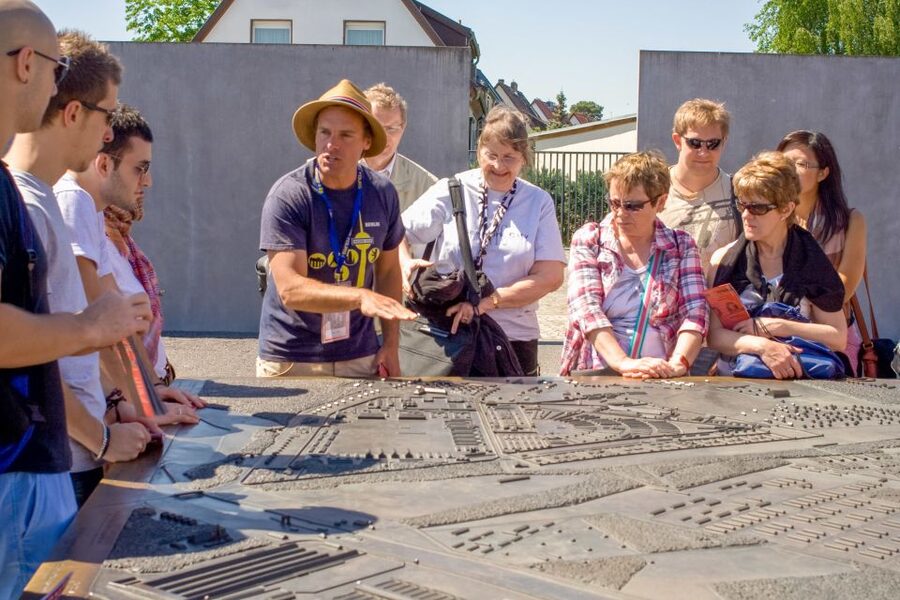
Your guided portion at the Sachsenhausen Memorial is about 2 hours, and it’s carefully shaped around the core areas that explain how the camp functioned. Expect a walk through the stark barracks and key parts of the grounds, with your guide translating what you’re looking at into something you can understand without turning away.
Here’s what the tour format does well:
You get enough time to cover multiple sites—without the day becoming a marathon. You also get the advantage of an expert guide explaining what you’re seeing, including the human impact and the administrative ruthlessness that made the violence efficient.
The tradeoff is simple: if you want to linger over every exhibit panel, you might wish for more time. The tour hits the essential markers, but it’s still time-limited.
Tower A and the commandant’s house: the psychology of control
At Sachsenhausen, Tower A is a must-see, and the tour doesn’t just point it out. You pass through the area where Arbeit Macht Frei still appears on the entrance—words that are deeply chilling when you understand the system behind them.
You’ll also visit the commandant’s house, which functions like a symbol of power and decision-making. Standing in that space after hearing how the camp was designed for maximum control can make the site feel less like a battlefield ruin and more like an office for brutality.
Your guide’s job here is crucial: they help you interpret the buildings not as ruins, but as parts of a functioning system. That is what turns a walk into a lesson.
Crematoria, gas chamber areas, and the execution trench
This part of the route is heavy. The tour includes sites such as the gas chamber, crematoria, and an execution trench, along with areas tied to confinement and punishment. You’re guided through the spaces with the explicit goal of helping you understand what happened—not to shock you for shock’s sake.
If you’re someone who gets overwhelmed by emotional intensity, this is where you’ll feel it most. A practical tip: pace yourself mentally. Don’t rush through the stops like you’re sightseeing. The tour gives you a respectful cadence and includes time to reflect at key moments, which helps you stay present.
Also, take the subject matter seriously. Alcohol and drugs are not allowed, and your best move is to bring yourself ready to pay attention—comfortable shoes, a steady pace, and a calm mindset.
Isolation and punishment cells: where routine turns into torment
Sachsenhausen included areas for isolation and punishment, and the guided walkthrough brings you to those critical spaces. These stops can feel repetitive in a certain way, because the buildings are stark and the purpose is the same: breaking people through confinement and violence.
What makes the tour valuable is that it doesn’t treat these rooms as separate horror stories. It explains them as part of a system that managed prisoners through terror, discipline, and forced routine. When you connect isolation and punishment to the larger structure of the camp, the site becomes more coherent—and more frightening.
The infirmary barracks: experimentation during the war
Another key highlight is the visit to the infirmary barracks. The tour description specifically points to experimentation during the war, and your route through these buildings is framed as a reminder of how cruelty extended even into medical spaces.
This is the section where the guides’ approach matters a lot. The tour aims to explain the historical mechanisms without sensationalizing suffering. Expect an explanation that links what happened in the infirmary to the camp’s overall brutality, including the broader death and disease toll.
You’ll also hear that about 35,000 people were murdered or died of disease at Sachsenhausen. Those numbers are hard to hold in your head, but the guide’s role is to place them in context so you don’t just absorb facts—you understand why the memorial preserves these spaces.
How the tour handles time, questions, and reflection
Because the memorial portion is only 2 hours, you’ll need to accept a tradeoff. Some people want more time in specific exhibit rooms, especially if you prefer reading documents and looking closely at interior displays. That said, the guided structure is what makes it possible to cover the most significant parts of the site without losing the storyline.
A practical way to get the most out of the fixed timing:
- Take questions at the moments your guide offers them, instead of saving everything for the end.
- Use your camp map to track where you are and what’s next.
- If you’re traveling with teens or someone who needs time to process, slow down during reflection points instead of rushing ahead.
Some guides also handle real-world timing changes due to closures on certain dates. If access changes, you’ll likely still get a coherent route because the commentary is built around understanding the camp system, not just checking off a list of rooms.
Transport, comfort, and practical value for the $55 price
At about $55 per person for a 4-hour day, the value comes from three things working together: transport, guided interpretation, and the memorial entry. You’re not paying just for the bus ride. You’re paying for someone to translate Sachsenhausen from confusing geography into a clear, structured understanding.
The tour also includes:
- Licensed guide
- Transportation by private air-conditioned vehicle
- Sachsenhausen Memorial entry
- A €3 donation per person to the memorial
- A map of the former concentration camp
- Driver
In other words, it’s not an expensive add-on. It’s paying for the parts that take the most effort and context if you try to do it yourself—especially when you want an English explanation at a pace that still respects the site.
Where this tour fits best (and who might want something else)
This is a strong choice if you want one guided visit that connects the camp layout to the system behind it. It also fits well if you’re new to the subject and you want your visit shaped by a coach lecture and a structured walkthrough.
It may not fit as well if you:
- Prefer long, self-paced time reading every exhibit room
- Need step-free access, since the tour is not wheelchair accessible
- Want full flexibility to choose which buildings you prioritize beyond the main route
Should you book the Berlin to Sachsenhausen English bus tour?
If you want a focused, respectful English-guided visit with a smooth Berlin-to-memorial day plan, I think booking makes sense. The tour is designed to cover the essential sites and explain how they connect, which is exactly what you need at a place as complex as Sachsenhausen.
Book it if you value interpretation and guidance over total freedom. Consider another approach if you’re hoping for unlimited time inside every building or you need wheelchair-friendly access.
FAQ
How long is the Berlin to Sachsenhausen bus tour?
The total experience is about 4 hours, with roughly 50 minutes of coach time each way and a guided visit of about 2 hours at the Sachsenhausen Memorial.
Where do I meet my guide in Berlin?
You meet outside Friedrichstraße train station, on the square between the Tränenpalast (Palace of Tears) and the station. Guides wear a blue lanyard and a yellow name tag holding yellow umbrellas.
What’s included in the price?
You get a professional licensed guide, transportation in a private air-conditioned vehicle, the driver, entry to the Sachsenhausen Memorial, a €3 donation per person to the memorial, and a map of the former concentration camp.
Is the tour wheelchair accessible?
No. The tour is not wheelchair accessible and is not recommended for people with limited mobility or walking impairments.
What should I bring, and what is not allowed?
Bring comfortable walking shoes and you can bring a camera. The tour also suggests bringing a light snack and drink. Alcohol and drugs are not allowed.
Can I cancel and get a full refund?
Yes. You can cancel up to 24 hours in advance for a full refund.