Barbed wire stays with you. This Berlin to Sachsenhausen day trip is built around an air-conditioned bus ride plus live English (and Spanish) commentary, so you’re not stuck figuring out transit while carrying a heavy topic. I also like that the on-site route hits the hard-stop places most people want to understand fast, from Tower A to the crematoria and gas-chamber area, with clear explanations. One drawback: the guided time at the memorial is limited to about 2 hours, so if you want to linger quietly in every corner, you may feel the clock.
You meet your guide at Friedrichstraße train station, right by the square beside the Tränenpalast area, and the guides are easy to spot with a blue lanyard and yellow umbrella. You get entry to the memorial and a small map of the former camp—helpful, because Sachsenhausen is laid out in a way that can feel confusing on a first visit.
In This Review
- Key points I’d plan around
- From Friedrichstraße to Sachsenhausen: the bus ride that sets the tone
- The memorial walkthrough: barracks, routines, and what the camp was built to control
- Oranienburg on the route: seeing where forced labor was tied to the camp
- The worst parts of Sachsenhausen: crematoria, isolation cells, and the machinery of death
- Commandant’s house and Tower A: propaganda, authority, and design
- How guides like Ariel, Paul, and Nickolai shape the experience
- Value check: is $49 for a Sachsenhausen bus tour worth it?
- Logistics that actually matter: shoes, pacing, and what to bring
- Who this tour is best for in your Berlin itinerary
- Should you book the Sachsenhausen bus tour from Berlin?
- FAQ
- How long is the Berlin to Sachsenhausen bus tour?
- Where do I meet the guide in Berlin?
- Is the tour offered in English?
- What’s included in the price?
- Is hotel pickup included?
- How much walking is involved?
- What should I bring?
- Are there any restrictions on the tour?
Key points I’d plan around
- Two hours on-site, guided to make sense of Sachsenhausen without losing your bearings
- Drive through Oranienburg en route, so you understand where prisoners would have worked
- You see the core sites like Tower A, crematoria, execution area, and infirmary-related spaces
- English live commentary (plus Spanish) on the bus and at the memorial
- Map + memorial entry included, plus a €3 donation per person to the Sachsenhausen Memorial
From Friedrichstraße to Sachsenhausen: the bus ride that sets the tone
This tour is designed around one practical goal: get you out of Berlin and into Sachsenhausen with context, fast. The meeting point is outside Friedrichstraße train station on the square by the Tränenpalast area. Look for your guide with a yellow umbrella and a blue lanyard—this matters because you don’t want to lose time hunting in the middle of a tight schedule.
Once you board, the bus ride isn’t just transit. The commentary starts en route and helps frame what you’re about to see—how Sachsenhausen functioned inside the Nazi camp system and why it was planned for control and expansion. That pre-arrival setup changes the whole experience. You arrive not just with facts, but with a mental map of what the camp was built to do.
Timing-wise, you’re on the coach for about 50 minutes each way. That structure also helps if your Berlin days are packed with other stops. Instead of trying to stitch together trains and walking paths on your own, you get a clear, single-day rhythm—without cutting corners on historical context.
The memorial walkthrough: barracks, routines, and what the camp was built to control
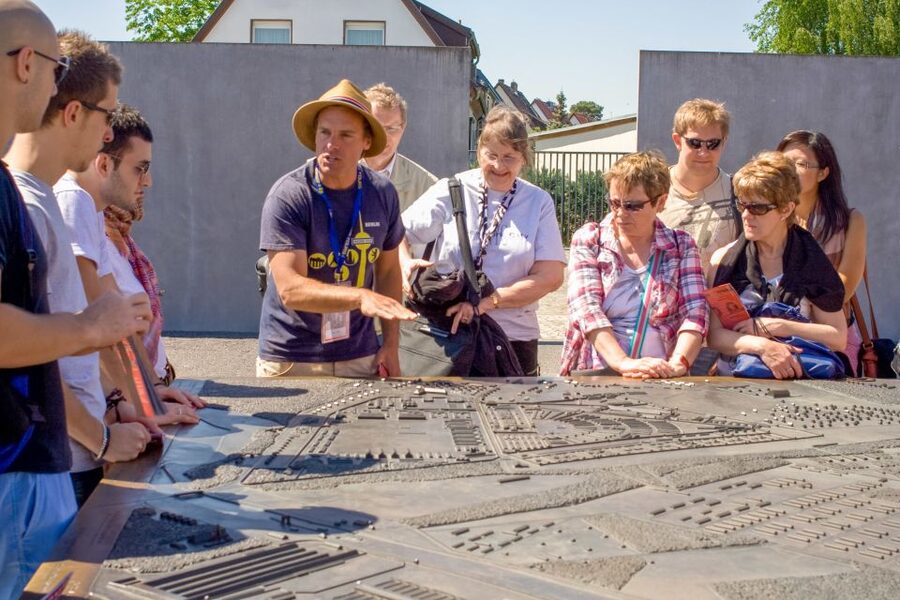
At Sachsenhausen Memorial, you’ll get a guided visit of about 2 hours. That’s enough time to cover the key areas, but not enough time to slowly process every detail. The sweet spot is that the guide does the heavy lifting of organizing the story for you while you’re standing in the actual spaces.
The core of the visit focuses on the barracks and daily routines—how prisoners were brutalized through schedules, forced movement, and harsh living conditions. You’re shown the interior camp layout, and you learn how Sachsenhausen fit into the broader network of camps during the war era. The guide’s job here is to explain how the system worked administratively, not just emotionally. It can be uncomfortable information, but it’s the kind that turns a memorial visit into understanding rather than just witnessing.
You’ll also pass major symbolic areas. Tower A is part of the route, and the phrase Arbeit Macht Frei remains visible above the entrance. It’s chilling because it’s both propaganda and architecture—built into the camp’s design rather than floating in history books. Your guide helps you interpret why that kind of messaging mattered to the camp’s control system.
Oranienburg on the route: seeing where forced labor was tied to the camp
One of the most distinctive aspects of this tour is that you don’t only see Sachsenhausen itself—you also get a drive through Oranienburg. This matters because a concentration camp wasn’t just a fenced-off location. It was part of an economy of coercion, and prisoners were used for work tied to the surrounding area.
By learning where inmates would have worked, you get a broader sense of how the camp affected life beyond barbed wire. It connects the memorial to the real geography around Berlin and helps you avoid the common mistake of treating the camp as an isolated setting. Even from the bus, that outside context helps you understand why the camp’s influence reached into the region.
If you like your history grounded in place—where things happened, not just when—this added route detail is a real plus. It also makes the morning feel more purposeful, so you don’t reach the memorial already mentally exhausted from a bus ride without meaning.
The worst parts of Sachsenhausen: crematoria, isolation cells, and the machinery of death
This is the portion of the tour you’ll remember, because it’s also the portion that’s hardest to look at and hardest to forget. The guided route includes the crematoria and the gas chamber area, along with the execution trench and other punishment-related spaces. You also see infirmaries and areas tied to experimentation during the war.
A key point: you’re not just walking past these areas. The guide explains how they fit into the camp’s operation—how violence was organized and repeated, not random or chaotic. That structural explanation is what helps many people make sense of the scale: you’ll learn about how 35,000 people were murdered or died of disease within the camp context. Hearing that number with the buildings and sites in front of you lands differently than reading it.
You’ll also visit spaces connected to brutal treatment, including isolation cells and punishment cells. These stops are designed to show how control worked at the level of bodies and movement—confinement as a tool, not an accident. Your guide’s tone usually matters here. Many guides on past tours—like Ariel, JR, and Nickolas—are specifically praised for being professional and respectful while still answering questions clearly.
Even if you know some camp history already, this segment often clarifies what people mean when they say the Nazi camp system was designed for efficiency. It wasn’t just persecution; it was management.
Commandant’s house and Tower A: propaganda, authority, and design
Two stops help you understand who ran the place and how authority was displayed. You’ll see the commandant’s house, which functions as a quiet “who held power” reminder. It’s one thing to learn about names in history. It’s another to stand near the spaces connected to decision-making and command.
Then comes Tower A. The visual impact hits right away because the slogan above the entrance is still there. Your guide ties that message back to control—why the system used lies, intimidation, and forced labor language to shape prisoners’ experiences and the outside world’s perception.
I like that the tour doesn’t treat these as spooky set pieces. It explains why they matter in the story of Sachsenhausen. That’s what keeps the visit from becoming only emotional. You walk away understanding how the camp’s structure supported its purpose.
How guides like Ariel, Paul, and Nickolai shape the experience
The quality of a guide can make or break a memorial tour. The strong pattern in the feedback is consistent: guides are praised for clear explanations, professionalism, and staying sensitive to the topic. Names that come up repeatedly include Ariel and Nickolas for thorough, structured storytelling, plus Paul and Dr Thomas for the way they connect camp details to broader German history.
Some guides also stand out for how they handle questions and keep the pacing workable for a mixed group. For example, guides like JR and Rebecca are mentioned as easy to listen to and responsive. That matters because people process history differently. When the guide gives you room to ask questions and doesn’t rush answers, you end up leaving with a more coherent understanding.
Also worth noting: the tour is offered in English and Spanish, so you’re not relying on translation apps. Live commentary helps you keep pace with the visual locations—especially in a camp where similar-looking barracks and courtyard areas can blur together quickly without guidance.
Value check: is $49 for a Sachsenhausen bus tour worth it?
For about $49 per person, you’re paying for three big things: transportation, a licensed guide, and memorial entry (plus a small donation). The bus is private and air-conditioned, and you’re not responsible for figuring out how to get to the memorial on your own. That convenience adds real value in Berlin, where time can disappear fast between transit, walking, and re-checking directions.
The other value piece is the guided 2-hour walkthrough. Sachsenhausen is not “just another stop.” Without context, it’s easy to walk around and miss the internal logic of the camp’s design and function. With a professional guide, you’re getting structured explanations tied to the exact places.
You also receive a map of the former concentration camp. It’s a small add-on, but it helps you connect what you saw to what you read later—especially if you’re planning to continue with other Holocaust-related sites.
The one reason the price might feel steep to some people is time: you only spend about 2 hours in the memorial area. If you want a longer, slower self-guided experience at the site, this tour may feel brief. Still, the combination of bus + guided narrative is why many people find it a good “make the most of a half-day” option.
Logistics that actually matter: shoes, pacing, and what to bring
This tour is weather-dependent only in the way many outdoor memorial visits are. You’ll be walking on site and standing in multiple locations, so comfortable shoes are non-negotiable. Bring a camera if you want photos, but keep in mind you’re visiting a memorial where respectful behavior matters.
Do not show up empty. The tour suggests bringing a light snack and a drink. That’s not a luxury; it helps you stay alert during a narrative that can be emotionally draining and information-heavy.
Also remember the simple rules: alcohol and drugs are not allowed. If you take medication, plan your day normally, and make sure you can move comfortably even when you feel tense or overwhelmed.
Finally, note the tour length. It’s about 4 hours total, and the on-site part is roughly 2 hours. That pacing is tight enough that you should treat this as the guided “core understanding” version of Sachsenhausen, not a slow personal contemplation session.
Who this tour is best for in your Berlin itinerary
This experience fits best if you want a focused, English-guided introduction to Sachsenhausen without spending your day juggling logistics. If you’re also planning other big Berlin stops—like museums, historic neighborhoods, or a second day trip—this tour gives you a clear half-day slot.
It’s also a good pick if you like learning through place-based interpretation. You’ll see Tower A, the commandant’s house, crematoria and gas chamber areas, execution-related spaces, infirmaries, and barracks. You’ll also get the Oranienburg drive detail, which helps the story extend beyond the memorial grounds.
If you’re traveling with a group and want an organized experience, the option for private or small groups can help keep the pace and question time comfortable. And if you’re planning to visit Auschwitz later, this tour’s structure can help you understand what to look for when comparing camps and their systems.
Should you book the Sachsenhausen bus tour from Berlin?
Yes—if you want the best balance of transportation ease, clear guidance, and time efficiency. For many people, the biggest win is that you don’t arrive to Sachsenhausen with confusion. You arrive with a framework, then walk through the key sites with live commentary in English.
I’d especially book it if you’re short on time in Berlin or if you’d rather spend your energy learning than planning transit. The 2-hour memorial tour is short, but it’s purposely designed to cover the places that help you understand how the camp worked and why it mattered in the Nazi camp system.
If you know you need hours and hours of quiet reflection on your own, you might prefer a longer independent visit. But for a well-organized, English-guided Sachsenhausen experience with a convenient air-conditioned bus ride, this is a strong choice.
FAQ
How long is the Berlin to Sachsenhausen bus tour?
The total duration is about 4 hours, with a guided visit at the Sachsenhausen Memorial lasting about 2 hours.
Where do I meet the guide in Berlin?
You meet your guide outside Friedrichstraße train station, on the square between the Tränenpalast (Palace of Tears) and the station. The guide will have a blue lanyard and a yellow name tag holding a yellow umbrella.
Is the tour offered in English?
Yes. Live guides are available in English, and Spanish is also offered.
What’s included in the price?
Included are a professional licensed guide, transportation by a private air-conditioned vehicle, the driver, Sachsenhausen Memorial entry, a €3 donation per person to the memorial, and a map of the former concentration camp.
Is hotel pickup included?
No hotel pickup and drop-off are included.
How much walking is involved?
You will walk through multiple areas of the memorial during the guided portion, so comfortable shoes are recommended.
What should I bring?
Bring comfortable walking shoes and a camera. The tour also advises bringing a light snack and a drink.
Are there any restrictions on the tour?
Alcohol and drugs are not allowed.