Two days of Seville, one ticket. I like how this 48-hour hop-on hop-off route stitches together big sights—from Torre del Oro to Plaza de España—without you having to plan every hop. You can get oriented fast, then come back later where you want more time.
My second love is the audio guide, offered in multiple languages, which helps you connect the dots as the bus moves through different neighborhoods. One possible drawback: stop-by-stop details are light, so if you show up with no plan, you may feel unsure about how long to spend at each stop.
In This Review
- Quick hits before you board
- Two days of Seville, one ticket that actually helps you plan
- Start at Torre del Oro: a smart way to get your bearings
- Seville Aquarium stop: a family favorite and an easy win for time-starved days
- Parque de María Luisa and Plaza de España: the iconic pair, accessed with less stress
- Old Tobacco Factory: a stop for architecture fans and history buffs
- Cartuja de Sevilla and La Cartuja island: monastery calm + Expo 92 context
- Isla Mágica: a practical add-on if your day needs fun
- Triana and Los Remedios vibes: flamenco streets and the ride between neighborhoods
- Alameda de Hércules, Plaza del Duque, and Plaza de Armas: where the city feels alive
- Audio guide in 8 languages: the value is in how you use it
- Included perks: wine, cava, and discounts that can offset the ticket
- On-time bus service and the real payoff of narrow streets
- Who this hop-on hop-off bus suits best
- Should you book the Seville 48-hour hop-on hop-off bus?
- FAQ
- How much does the Seville Hop-On Hop-Off Bus Tour cost?
- What is the duration of the tour?
- Where is the meeting point?
- Does the tour end back at the meeting point?
- Is the ticket mobile?
- What languages are available for the audio guide?
- Are drinks and discounts included?
- Is food included?
- What is the cancellation policy?
- Is there a maximum group size and are service animals allowed?
Quick hits before you board
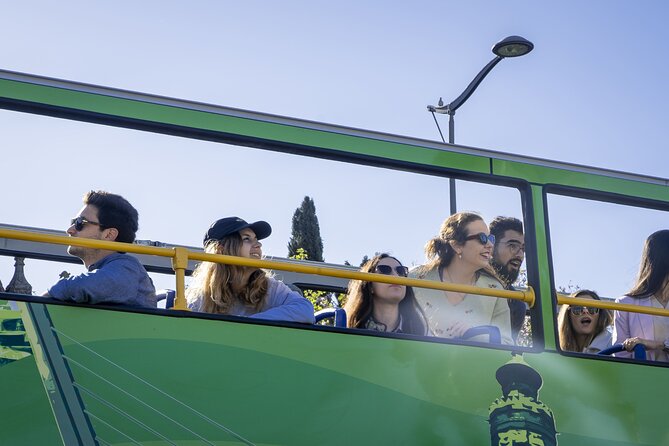
- Two-day flexibility: keep the ticket and hop on again for 48 hours.
- A strong sights loop: Torre del Oro, Plaza de España, Triana area, and Cartuja show up on the route.
- Audio guide in many languages: Spanish, English, French, Russian, German, Italian, Dutch, and Portuguese.
- Aquarium stop with real scale: 35 aquariums and animals from 400+ species.
- Perks with your ticket: a wine chato, a glass of cava, plus discounts tied to specific venues.
- Narrow-street maneuvering: part of the fun is seeing the bus work through Seville’s tight lanes.
Two days of Seville, one ticket that actually helps you plan
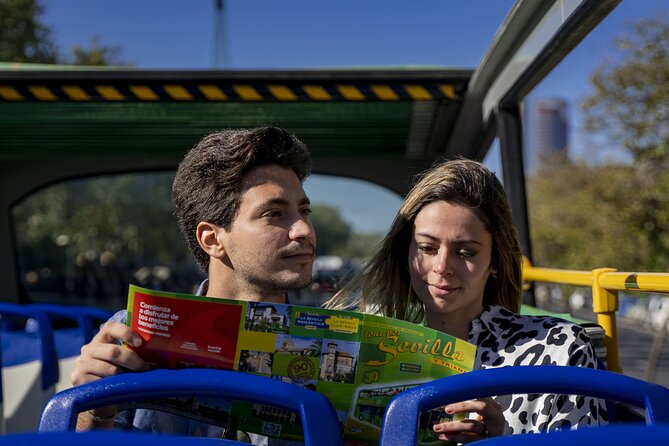
Seville can feel huge when you land, even when the center is compact. This kind of hop-on hop-off pass turns the city into something you can manage: ride the loop, mark what you like, then return on your own time. The total time for a full circuit is about 1 hour 35 minutes, but your real advantage is stretching that into 48 hours so you’re not racing the clock.
At around $29.52 per person, the ticket isn’t just about transportation. You’re also paying for the structure: a guided route, an audio guide, and a handful of included perks. If you plan to visit Plaza de España and the Cartuja area anyway, the bus becomes a practical shortcut—especially on a first day when you’re still learning where things sit.
One more plus: the bus route covers a mix of Seville styles, from monument-heavy plazas to university and old-industry zones. That variety matters because Seville isn’t one mood. You want options—then you choose your favorites once you’re physically there.
Start at Torre del Oro: a smart way to get your bearings
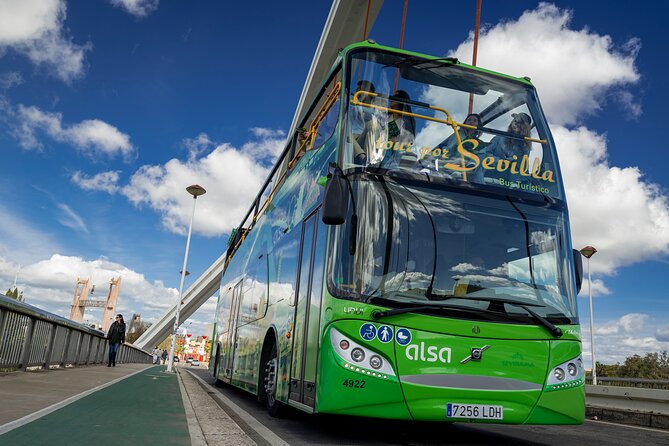
The ride starts at Paseo de Cristóbal Colón, near the historic waterfront, and the overall route is anchored by the Torre del Oro area. I love this choice because it gives you a clear “home base” vibe. The tour also ends back at the meeting point, so you’re not scrambling to figure out how to get back after your last stop.
Once you’re aboard, the bus does an important job: it connects the dots between separate parts of Seville that feel far apart when you’re walking. You’ll pass key landmarks and major streets while staying in one seat. That means less time hauling yourself across town, more time noticing neighborhood character and planning your next hop.
Practical tip: don’t think of the audio guide like background noise. Use it like a map. When you hear a stop described, glance out the window and locate where you are relative to what you’re going to see. That small habit makes your first hop much smoother.
Seville Aquarium stop: a family favorite and an easy win for time-starved days
One of the clearest “do not skip” stops is the Seville Aquarium. The stop is described as housing 35 different aquariums with animals across 400+ species. Even if you’re not an aquarium person, it’s a solid way to break up a walking day and cool off when the sun gets intense.
Why this stop works with a hop-on pass: it gives you a structured indoor option. With only limited time, people often overschedule. An aquarium slot is the kind of plan that keeps the day from falling apart.
When you hop here, give yourself enough time to actually move between viewing areas rather than treating it like a quick glance. If your goal is mainly photos, you can rush it, but you’ll probably get more satisfaction if you treat it like a stop, not a detour.
Parque de María Luisa and Plaza de España: the iconic pair, accessed with less stress
The route heads into the Parque de María Luisa area, with stops that line up with the famous plazas inside the park. The tour includes Plaza de España as an architectural complex in María Luisa, which makes sense because this is one of Seville’s most photo-friendly settings.
What I like about using the bus for this: you can time your visit to match your energy. On the first pass, you can do a quick orientation. Then, when you’re ready, you can hop off for a longer walk through the surrounding paths and viewpoints around the plaza.
Plaza de España rewards slower movement. The setting isn’t just a single view; it’s a space you circle. If you rush straight from one bench to the next, you miss the full effect. With hop-on access, you can build a return visit without feeling locked in.
Old Tobacco Factory: a stop for architecture fans and history buffs
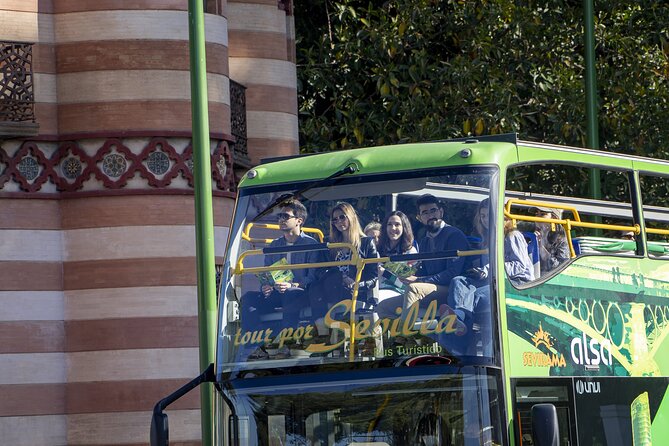
The route also includes the Old Tobacco Factory (Fábrica de Tabacos). This is one of those Seville landmarks where the building’s presence does some storytelling even if you don’t go deep into context.
It’s a good stop when:
- you like “big building moments,”
- you want a break from open plazas,
- you enjoy noticing how Seville’s city life sits beside major institutions.
I’ll be honest: with this type of audio-guided hop-on service, you may not get the depth you’d want if you’re chasing specific details. Still, the stop is valuable because you’ll see the scale and placement up close—then you can decide if it’s worth a longer visit on your own.
Cartuja de Sevilla and La Cartuja island: monastery calm + Expo 92 context
Now for the quieter switch in scenery: the tour heads to Cartuja de Sevilla on La Cartuja island. The site is described as one of the four Carthusian monasteries in Andalusia, and it also ties into Expo 92. It’s a lot for one stop, but the bus route makes it manageable.
I like this area because it’s a change from the city center. Even when you only spend an hour here, the atmosphere feels different. You get open space, big building silhouettes, and a sense of place that doesn’t feel like just another plaza.
If you want the best payoff:
- hop off with enough time to walk the grounds at a slow pace,
- use your audio guide to connect the monastery aspect to what Expo 92 left behind.
This is also a smart stop for people who want a balance: one part Seville classic, one part Seville “outside the postcard.”
Isla Mágica: a practical add-on if your day needs fun
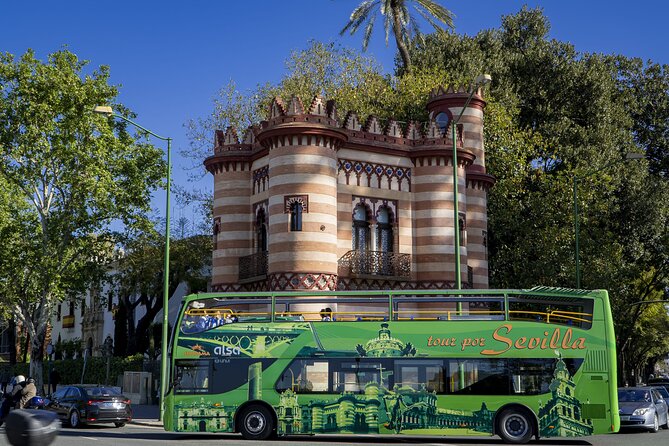
The route includes a stop at Isla Mágica, the theme park located on La Cartuja with a setup tied to the discovery of America. If you’re traveling with kids—or you just want a lighter, entertainment-focused break—this is an easy hop.
The practical advantage is timing. If you’re not ready to commit to the park, you can still use the stop to reposition yourself near Cartuja and decide later. If you do go, you’ll probably feel less frantic knowing you can hop back onto the bus to keep moving.
Even if you’re not park-bound, it’s worth noticing how the theme fits into the La Cartuja setting. It’s another layer to the area that makes it feel like a planned destination rather than random outskirts.
Triana and Los Remedios vibes: flamenco streets and the ride between neighborhoods

Your route also passes through areas tied to Triana, known for flamenco and handicrafts, plus Plaza de Cuba in Los Remedios. I like these stops because they help you sample neighborhood character without turning the day into a scavenger hunt.
Here’s the key: neighborhood spots are rarely about one single must-see building. They’re about streets, atmosphere, and the fact that the city changes as you move. The hop-on pass helps you catch those shifts quickly, then commit to a second walk if you find a pocket you love.
If you want to make Triana and Los Remedios land well, treat them like “choose-your-own-adventure zones.” Hop off, walk a few blocks, then decide if you want to linger. With the two-day ticket, you’re not stuck.
Alameda de Hércules, Plaza del Duque, and Plaza de Armas: where the city feels alive
Later in the loop you’ll encounter Alameda de Hércules, described as dominated by the wide square and popular with students and creative people. The tour also includes finishing points tied to Plaza del Duque in central Seville and Plaza de Armas as a bus station stop before you loop back.
This is where the bus route feels most helpful for adults with mixed interests. After monuments and major sites, it’s nice to have places that feel social and everyday. Alameda de Hércules is the kind of stop where you can grab a drink, people-watch, and reset your energy before continuing.
Plaza del Duque and Plaza de Armas are also helpful as “navigation anchors.” Even if you only spend a short time at each, they make the route feel less like a string of random tourist points and more like a city system.
Audio guide in 8 languages: the value is in how you use it
The audio guide covers Spanish, English, French, Russian, German, Italian, Dutch, and Portuguese. That’s great for mixed-language groups or if you’re traveling with someone who wants their own language track.
The biggest value isn’t that you can press play—it’s that you can reduce decision fatigue. When you know what you’re looking at, you spend less energy guessing, and more energy noticing.
Tip: plan one “long hop” and one “quick hop” per day. Use the audio guide for the long hop site so you get the context. For the quick hop, use it just to confirm you picked the right area, then move on.
Included perks: wine, cava, and discounts that can offset the ticket
This is where the tour gets more interesting than a basic sightseeing bus. Your ticket includes:
- a free drink at Taberna el Papelón (a chato of red or white wine) when you present your ticket
- a glass of cava at Casa Carmen Platillos Restaurant with your ticket
- a 20% discount at Plaza de Toros
- a 20% discount on admission to Hospital de la Caridad
Since food and drink aren’t included beyond those listed items, you’ll still pay for meals. But these included extras can meaningfully soften the overall cost if you’re planning to check out one or two of the discounted spots anyway.
To get the best value, think like this: if you already want Plaza de Toros or Hospital de la Caridad, the discounts make sense. If you don’t, the wine and cava still work as a bonus that feels more like a local touch than a generic voucher.
On-time bus service and the real payoff of narrow streets
One thing I appreciated is that the bus runs on time, and the ride itself is part of the experience. The bus has to maneuver through Seville’s tight streets, and that’s actually entertaining in a practical way. You feel the city’s layout, not just see it from a distance.
That matters because hop-on tours can sometimes feel like slow, stop-and-go tourist shuttles. Here, the bus movement helps you understand where the main sights sit relative to each other. It’s easier to picture a walking route after you’ve already seen the roads.
Just remember: audio guide and landmarks are great, but the bus can’t replace local strolling. When you find a neighborhood you love, you’ll want to step off and walk.
Who this hop-on hop-off bus suits best
This works especially well if you:
- want a clean first-day orientation,
- prefer a flexible schedule over a fixed walking itinerary,
- like mixing major monuments with neighborhood wandering,
- need an easy way to reach both the center and the Cartuja side.
It’s also a good fit for people who benefit from audio guidance. If you enjoy learning while you move, you’ll get more out of the ride.
If you want heavy, detailed narration at every stop, you may find it a bit light. This is more about routing and options than a deep lecture.
Should you book the Seville 48-hour hop-on hop-off bus?
I’d book this if you want a practical structure for two days in Seville, especially with stops that cover Torre del Oro, Plaza de España, Triana/Los Remedios, and La Cartuja. The included drink and discount perks also add value beyond the ride.
Skip it if you already have a tight, pre-planned walking schedule and you don’t plan to use discounted sites or indoor breaks. In that case, you might save money by building your own route by foot and bus.
FAQ
How much does the Seville Hop-On Hop-Off Bus Tour cost?
It costs $29.52 per person.
What is the duration of the tour?
The duration is about 1 hour 35 minutes (approx.). Your ticket is valid for 48 hours.
Where is the meeting point?
The tour starts at Paseo de Cristóbal Colón, P.º de Cristóbal Colón, Casco Antiguo, 41001 Sevilla, Spain.
Does the tour end back at the meeting point?
Yes, the activity ends back at the meeting point.
Is the ticket mobile?
Yes, the tour uses a mobile ticket.
What languages are available for the audio guide?
The audio guide is available in Spanish, English, French, Russian, German, Italian, Dutch, and Portuguese.
Are drinks and discounts included?
Yes. You get a free chato of red or white wine at Taberna el Papelón and a glass of cava at Casa Carmen Platillos Restaurant. There are also 20% discounts with your ticket at Plaza de Toros and Hospital de la Caridad.
Is food included?
No. Food and drink are not included, except for the specific drinks and discounts listed in the included benefits.
What is the cancellation policy?
Free cancellation is available. You can cancel up to 24 hours in advance for a full refund. Canceling less than 24 hours before start time is not refundable.
Is there a maximum group size and are service animals allowed?
The tour has a maximum group size of 30. Service animals are allowed.