
Two bus loops that turn chaos into order. In Saigon, I like the simple hop-on hop-off setup and the 9-language audio with headphones, so you can move at your pace while still learning what you’re seeing. The route choices also help you mix “classic sights” with more local neighborhood stops, without having to plan every minute.
One thing to keep in mind: the experience depends on your device and your ears. On some rides, the audio can be a little hit-and-miss in timing, and if a headphone unit has issues, you’ll feel it fast on a city full of road noise.
In This Review
- Quick Key Points Before You Ride
- Getting Oriented in Saigon: Two Routes, One Smart Pace
- Price and What the $21 Pass Really Buys You
- Comfort That Actually Matters in Ho Chi Minh City Heat
- Red Route: French Colonial Classics and the Big-Day Stops
- Saigon Opera House (Stop 1)
- Nguyen Hue Street (Stop 2)
- Nha Rong Wharf (Stop 3)
- Tran Hung Dao Statue (Stop 4)
- Museum of Vietnamese History (Stop 5)
- War Remnants Museum (Stop 6)
- Pham Ngu Lao Street (Stop 7)
- Ben Thanh Market (Stop 8)
- Independent Palace (Stop 9)
- Saigon Notre Dame Cathedral / Central Post Office (Stop 10)
- Blue Route: Flower Markets, Pagodas, and Market-Real Saigon
- Beer Street – Pham Ngu Lao Street (Stop 1)
- Ben Thanh Market (Stop 2)
- War Remnants Museum (Stop 3)
- Ho Thi Ky Flower Market (Stop 4)
- Phuoc An society’s premises (Stop 5)
- Ong Bon Pagoda (Stop 6)
- Binh Tay Market (Stop 7)
- Thien Hau Pagoda (Stop 8)
- Van Phat Pagoda (Stop 9)
- When a 1-Day Pass Works Best (and When You Need 2)
- Smart Line-Switching: How to Cover More Without Getting Lost
- Tickets, Vouchers, and Where to Actually Start
- Small Watch-Outs That Can Change Your Experience
- Audio sync and volume
- Stop clarity
- Walking distances after the stop
- Should You Book This Saigon Hop-On Hop-Off Bus Tour
- FAQ
- How long is the Red and Blue route?
- How often do the buses run?
- What are the first and last departure times?
- What’s included with the ticket?
- Is entry to attractions included?
- Can I use a mobile voucher or do I need paper tickets?
- Where do I exchange vouchers for tickets?
- What do I need to bring?
Quick Key Points Before You Ride

- Two routes (Red + Blue) let you cover a lot of ground without committing to one exact plan
- Headphones + 9 languages mean you can understand landmarks like Notre Dame and the War Remnants Museum as you pass
- Free Wi-Fi and a guidebook help you map the next stop while you’re on the move
- Frequent departures (every 30 minutes on Red, every 45 on Blue) reduce stress when traffic and crowds slow everything down
- Top deck views vs aircon comfort means you can choose sun and photos or shade and breathing room
Getting Oriented in Saigon: Two Routes, One Smart Pace
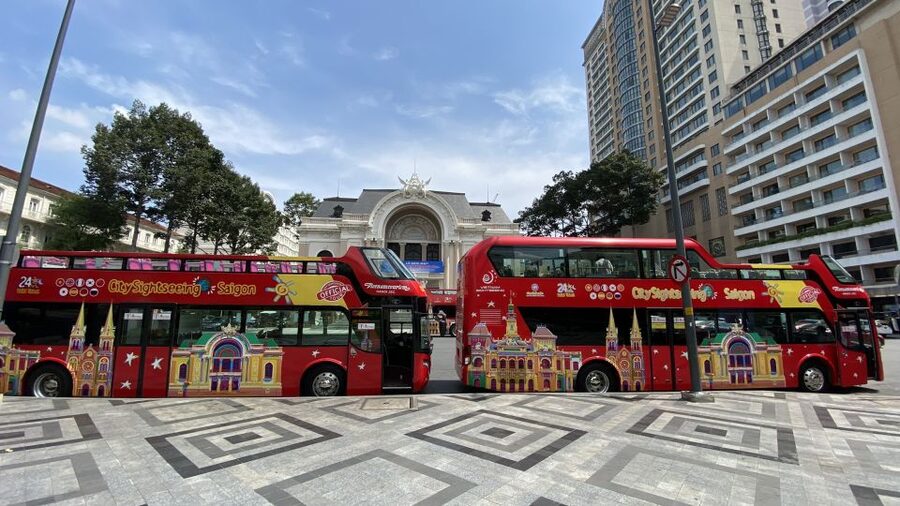
Saigon (Ho Chi Minh City) is big, fast, and at times noisy in a way that makes first-day planning feel like a test. This hop-on hop-off bus tour is built for exactly that problem: you get major landmarks on an easy loop, plus the freedom to hop off and come back later.
You’re offered a 1-day or 2-day pass, and the magic is that it’s not about “doing everything.” It’s about doing the right things for you. Want cathedral photos and colonial-style architecture? You’ll find it on the Red route. Prefer pagodas, markets, and neighborhoods beyond District 1? The Blue route steers you there.
The tour runs on two loops with different timing windows, so you can fit it around your other plans. Both start at 9:00am from Stop 1, with Red running later than Blue (Red last departure at 4:00pm; Blue last departure at 3:45pm).
Price and What the $21 Pass Really Buys You

At about $21 per person, the value comes from what’s included, not just the ride itself. You get audio commentary in 9 languages with headphones, plus free Wi-Fi and a free guidebook with maps, recommendations, timetables, and coupons. That’s useful because it turns the bus into a moving information desk.
Is it always cheaper than taxis or app rides? It can be, but it depends on how scattered your day gets. If you’re taking short, direct hops between nearby sights, you might find you can do it for less by using Grab. But once you start bouncing across districts, the bus tends to win on convenience. You’re paying for the “no thinking” factor and the fact that the bus already handles the driving and route direction.
Also, entry tickets are not included. That’s important for budgeting. You’re buying transportation and commentary, not museum passes. So think of this as your planning tool and your city-view ticket.
Comfort That Actually Matters in Ho Chi Minh City Heat
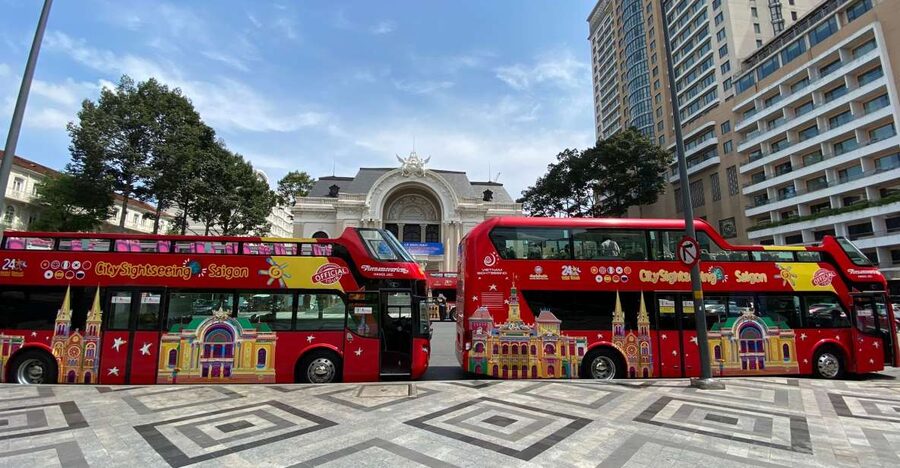
Saigon weather can go from bright to sweaty to rainy without much warning. What I appreciate here is that the bus setup lets you respond to conditions.
- If you want photos and skyline angles, the upper deck is where you’ll want to be at sunset and during clear stretches.
- If the sun is too much, you can move downstairs where it’s air-conditioned (a common request on hot days).
Staff assistance shows up in small but real ways. People report being offered hats for sun and ponchos when rain hits as they’re boarding or getting off. That’s not glamorous, but it makes the difference between a day that feels smooth and one that feels miserable.
One practical note: sound quality is crucial because the commentary comes through headphones. If you’re sensitive to low volume, try to test the headphones early and keep the volume at a level you can actually hear over street noise.
Red Route: French Colonial Classics and the Big-Day Stops

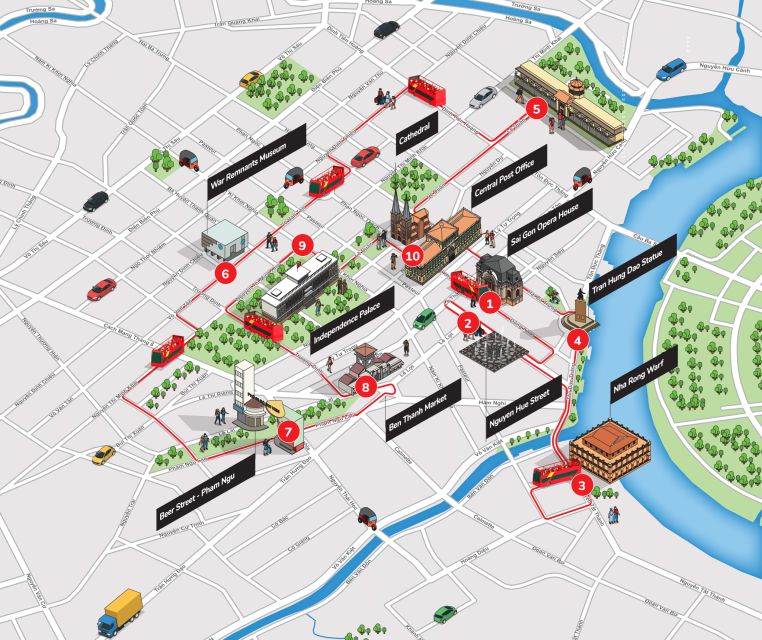
The Red route is your “first-time” line. It threads through some of Saigon’s most photographed architecture and the major central-area sights, with a tour length of about 75 minutes per loop and buses every 30 minutes.
Here’s how the Red route plays out stop by stop, and what each one is good for.
Saigon Opera House (Stop 1)
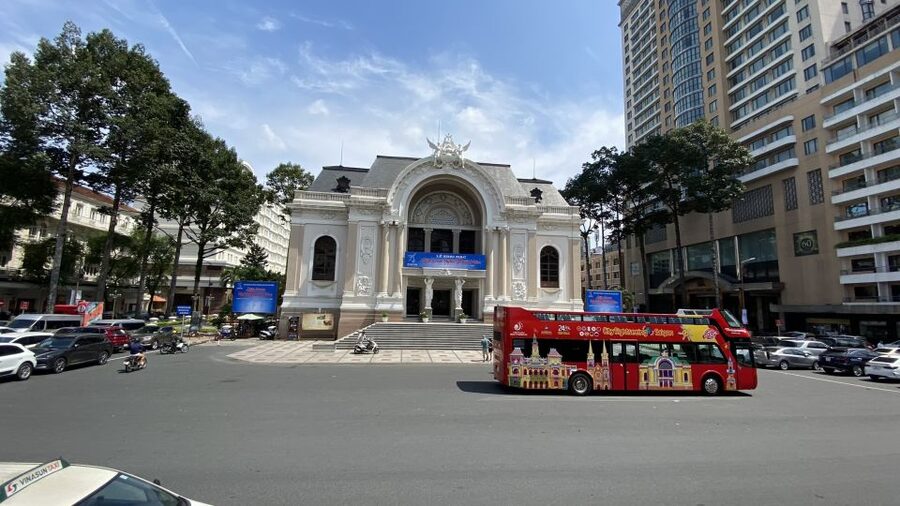
This is a great starting point because it puts you in the center of the city’s attention. If you’re exchanging vouchers, the ticket counter is on the side of the Saigon Opera House facing the Continental Hotel—so you’re not wandering for long trying to figure out where to begin.
If you want an easy “orientation lap,” start here and ride once before hopping off. You’ll learn where everything sits relative to major streets.
Nguyen Hue Street (Stop 2)
This is the classic main drag: shopping, foot traffic, and big-city energy. If you’re trying to line up dinner or find an ATM, it’s a practical stop. It’s also a good place to hop off for a short walk, since you can usually connect to other areas quickly.
Nha Rong Wharf (Stop 3)
This stop is your river and atmosphere break from buildings. It’s a solid photography spot when you want water views or when you’re imagining Saigon before it became all concrete and motorbikes.
Tran Hung Dao Statue (Stop 4)
It’s a quick visual landmark stop, useful for understanding where you are as the route runs through central blocks. You’ll get the most value if you’re looking at the map in your guidebook while the bus moves.
Museum of Vietnamese History (Stop 5)
If you want context before you hit major wartime sites, this is a smart move. Even when you don’t enter, passing by helps you place the narrative of modern Vietnam in your head.
War Remnants Museum (Stop 6)
This is one of the most important stops on either route. Plan time here, and don’t assume it will be a quick peek. The bus ride gives you access, but the museum experience needs your attention.
If you’re sensitive to heavy topics, it’s still worth visiting for understanding Saigon’s modern history, but choose the level of time that works for you.
Pham Ngu Lao Street (Stop 7)
Hop off here if you’re after food, convenience, or a more backpacker-friendly pocket of the city. This also helps you plan evenings and places to regroup after museums.
Ben Thanh Market (Stop 8)
This is the “yes, I want souvenirs” stop. It’s also a convenient place to grab a snack or plan a meal. Even if you mostly browse, it’s a good way to see how people shop and move through a market environment.
Independent Palace (Stop 9)
This stop is for history-lovers and architecture fans. It’s also a classic example of why a bus tour helps: you might not walk there on day one, but the bus drops you close enough that you can decide in minutes.
Saigon Notre Dame Cathedral / Central Post Office (Stop 10)
This is your big French-colonial photo zone. The cathedral and post office area is one of the most recognizable parts of Saigon, and it’s exactly the kind of place where you want a calm moment to look up and appreciate details.
It’s also a convenient end point for the day, since you’ll be close to the central tourist zone again.
Blue Route: Flower Markets, Pagodas, and Market-Real Saigon

The Blue route feels like the “go beyond the postcard” line. It covers different neighborhoods, with a loop of about 80 minutes and buses every 45 minutes.
If Red is your spotlight tour, Blue is your texture tour.
Beer Street – Pham Ngu Lao Street (Stop 1)
You’ll see this area more as a neighborhood and nightlife strip than a monument zone. If you want to plan a dinner stop or a drinks-with-a-view plan after the bus, this helps.
Ben Thanh Market (Stop 2)
Yes, it repeats. That’s not a mistake—it’s a practical anchor, so you can jump between routes without losing your footing.
War Remnants Museum (Stop 3)
Another anchor stop. It gives you a second approach if you started your day on Red and want to continue on Blue.
Ho Thi Ky Flower Market (Stop 4)
This is a sensory stop. You’ll likely want a slow walk and a few photos, especially if you love the color and local market rhythm. Flower markets also make a nice break from heavy museum content.
Phuoc An society’s premises (Stop 5)
This is a community-based stop. The practical value is simply that it takes you off the main tourist lane and into a more local interaction zone. Use your guidebook notes to decide if you want to step out and look around more.
Ong Bon Pagoda (Stop 6)
Pagodas are one of the best places to understand a city beyond its streets. This is a good stop for architecture, incense-and-silence moments, and respectful observation.
Binh Tay Market (Stop 7)
If you want “shopping as daily life,” this is a strong choice. Markets like this are often less about staged souvenirs and more about how locals move through a day.
Thien Hau Pagoda (Stop 8)
Another pagoda stop, giving you more than one place to compare styles and atmosphere. If you’re visiting more than one religious site, this helps you avoid the feeling of repeating the same thing.
Van Phat Pagoda (Stop 9)
Your final Blue-route temple stop. It’s a nice capstone if you’ve been hopping between marketplaces and worship spaces and want one last moment of quiet.
When a 1-Day Pass Works Best (and When You Need 2)
If you only have one day, I’d do this in two steps:
1) Ride the Red route once end-to-end for orientation.
2) Hop off for 1–2 key sights (often War Remnants Museum and Ben Thanh are the big picks), then return later.
A two-day pass is better if you want breathing room. It lets you:
- revisit a stop without panic,
- switch between Red and Blue across different parts of the day,
- and take your time around museums and markets.
One practical detail: buses run earlier than many people expect. Both routes start at 9:00am at Stop 1. If you hate arriving late and scrambling, start in the morning and plan a slower afternoon.
Some people also talk about an added evening loop where the city lights are the point, and that ride has been described as around 45 minutes. If your ticket includes an option like that, it can be a nice way to see Saigon differently without burning your whole night.
Smart Line-Switching: How to Cover More Without Getting Lost

You don’t have to treat Red and Blue as separate days. There’s a clear switch logic built into the routes, and it saves time.
The guidance is to switch on the Red route at Stops 6, 7, and 8, which line up with early stops on Blue. In plain terms:
- Red Stop 6 (War Remnants Museum) lines up with Blue Stop 3
- Red Stop 7 (Pham Ngu Lao area) lines up with Blue Stop 1
- Red Stop 8 (Ben Thanh Market) lines up with Blue Stop 2
So if you want a smooth plan, you can take Red until the War Remnants Museum area, then switch to Blue to continue toward pagodas and markets.
This matters because the routes share key anchors. Ben Thanh and the War Remnants Museum show up in both lines, so you can re-route your day on the fly if you change your mind.
Tickets, Vouchers, and Where to Actually Start
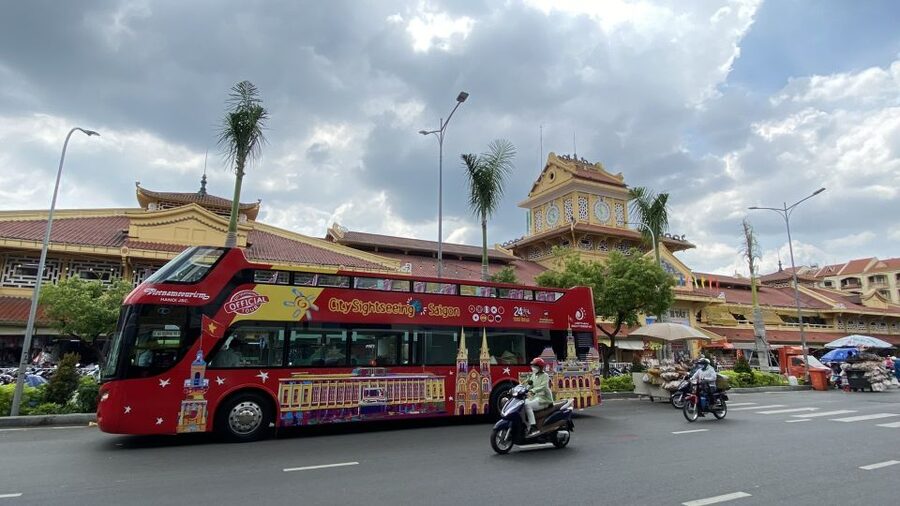
This tour is designed for easy pickup. Both mobile and paper vouchers are accepted.
If you need to exchange a voucher for a ticket, you can do it at the ticket counter on the side of the Saigon Opera House facing the Continental Hotel. Once you’re set, you can board whichever route you want and keep riding within your pass validity window.
Your pass is valid for 1–2 days, and vouchers can be used on any day within 12 months of the travel date you selected at checkout. That flexibility is useful if your schedule is still moving around.
Also, the driver’s English is available, and the audio guide is included in English, Spanish, German, French, Chinese, Japanese, Korean, Vietnamese, and Russian.
Small Watch-Outs That Can Change Your Experience
A hop-on hop-off bus sounds straightforward, but a few details can affect how satisfying the ride feels.
Audio sync and volume
Some riders report issues with audio alignment on certain buses, where the narration doesn’t perfectly match the buildings passing by. Others mention headphone volume might be too low. If you notice either problem, switch to another bus at the next stop instead of forcing it.
Stop clarity
One frustration that came up is that the bus stops aren’t always obvious. If you arrive at a stop and can’t quickly tell where to wait, double-check the route info in your guidebook and look for staff directions.
Walking distances after the stop
The bus stops are close, but not always front-door close. A few stops may require extra walking to reach the exact entry point of an attraction. If your feet are tired, choose sights that you can reach easily from where the bus lets you off.
Should You Book This Saigon Hop-On Hop-Off Bus Tour
Book it if you want a low-effort way to learn Saigon fast and decide later what you want to go back for. It’s especially good for first-timers because the Red route hits the headline sights, and the Blue route adds neighborhood character with markets and pagodas.
Skip it or reconsider if:
- you’re comfortable navigating on your own and already have a tight plan for each day,
- you mostly want taxis between far-apart spots (some people find app rides cheaper),
- or you’re very sensitive to audio timing and sound quality issues.
My practical recommendation: do one full loop early, take notes in your guidebook, then hop off for only the top 2–3 stops you truly care about. You’ll end up with a calmer day and better decisions, not just a checklist.
FAQ
How long is the Red and Blue route?
The Red route loop takes about 75 minutes, and the Blue route loop takes about 80 minutes.
How often do the buses run?
Red buses run every 30 minutes. Blue buses run every 45 minutes.
What are the first and last departure times?
Both routes start at 9:00am from Stop 1. The last Red departure from Stop 1 is 4:00pm, and the last Blue departure from Stop 1 is 3:45pm.
What’s included with the ticket?
You get the hop-on hop-off bus tour for 1–2 days, audio guide in 9 languages with headphones, free Wi-Fi, and access to both routes.
Is entry to attractions included?
No. Entry to attractions is not included.
Can I use a mobile voucher or do I need paper tickets?
Mobile and paper vouchers are both accepted.
Where do I exchange vouchers for tickets?
You can exchange tickets at the ticket counter on the side of the Saigon Opera House facing the Continental Hotel.
What do I need to bring?
Bring a passport or an ID card. Smoking isn’t allowed, and pets are not allowed.